Lather & Slow: Inside the Soap Studio That's Doing Everything the Hard Way
Nina Castillo spent eleven years in pharmaceutical research before burnout and a persistent eczema diagnosis sent her toward natural skincare. She couldn't find a soap that didn't wreck her skin. So she made one. Eighteen months later, the waiting list runs to six weeks.

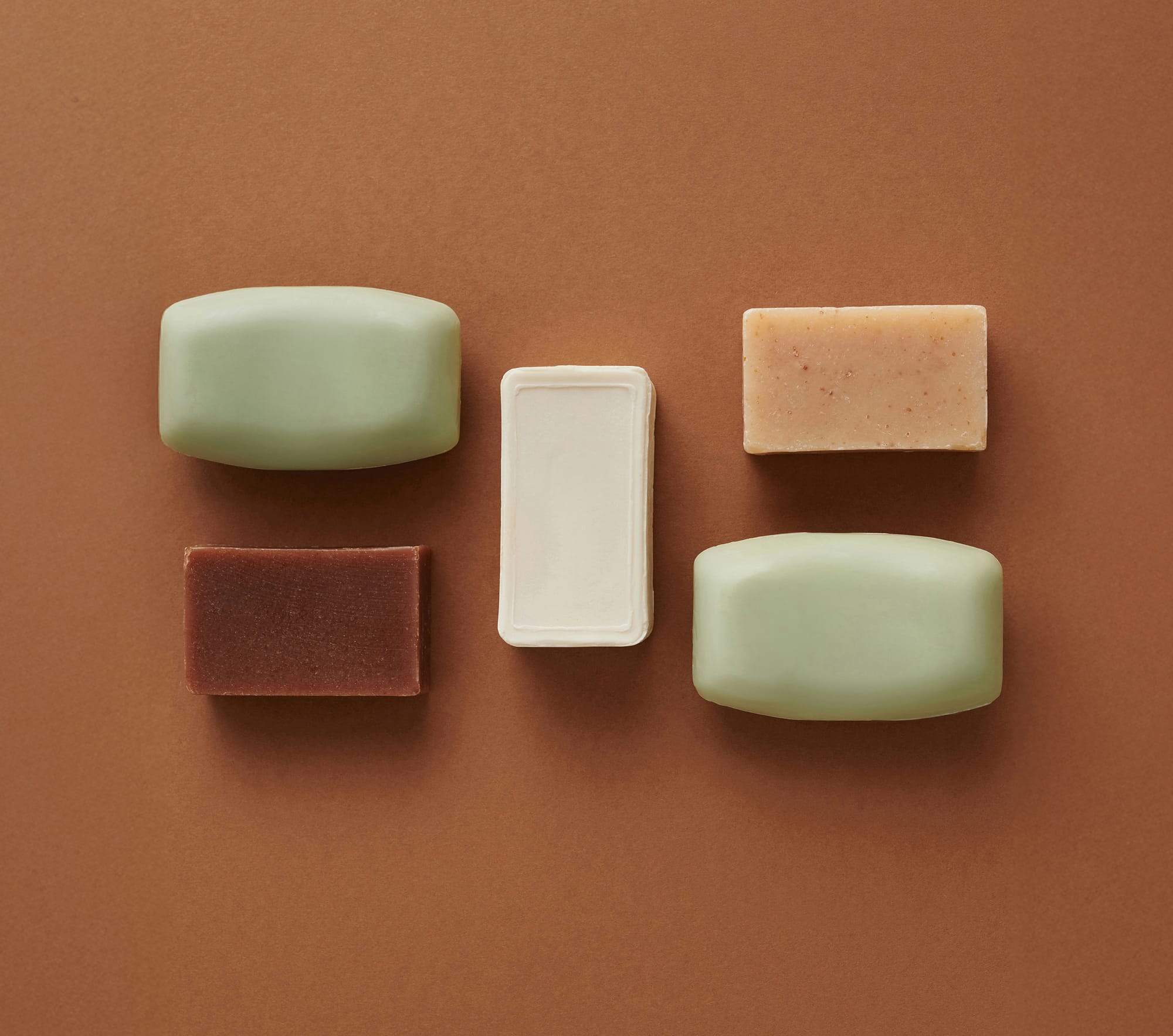
The soap on the table looks simple.
Five bars, arranged without ceremony on a warm terracotta surface — sage green, cream white, deep burgundy, sandy rose, soft jade. Different shapes, different textures, different scents that arrive before you've crossed the room. One is smooth and molded, the edges precise. Another is cut rough, its surface still grainy from the mold. A third has flecks of something visible beneath the surface — botanicals, maybe, or mineral pigment.
They are, each of them, the result of six weeks of work.
"People hear that and they think I'm being precious about it," says Nina Castillo, founder of Lather & Slow, pouring water into a vessel on the studio worktable with the measured calm of someone who has learned that rushing this part costs you everything. "I'm not. That's just how long cold process soap takes. You can't speed it up. The chemistry doesn't care about your timeline."
The Beginning
Nina Castillo did not set out to make soap.
She spent eleven years in pharmaceutical research — formulation chemistry, the science of how compounds interact in solution — before a combination of burnout and a persistent eczema diagnosis sent her toward natural skincare as both a professional pivot and a personal necessity.
"I was formulating drugs and I couldn't find a soap that didn't wreck my skin," she says, with the flat irony of someone who has told the story enough times to appreciate its absurdity. "So I started making my own. Which is what happens when a chemist can't find what she needs — she makes it."
The first batches were functional. The second were better. By the sixth month, friends were asking to buy them. By the end of the first year, she had a waiting list.
Lather & Slow launched officially eighteen months ago from a studio in her home, with five products and no marketing plan.
"I didn't have a strategy," she says. "I had soap that worked and people who wanted it. That felt like enough to start."
The Process
Cold process soapmaking is, at its core, a controlled chemical reaction — the saponification of oils and fats by an alkali, typically sodium hydroxide, that transforms the raw ingredients into soap and glycerin over a curing period of four to six weeks.
It is also, in Castillo's hands, something considerably more considered than that description suggests.
The oils she uses are sourced individually — a shea butter from a Ghanaian cooperative she has visited in person, an olive oil from a small Andalusian producer she found through a food contact, a kokum butter from India that she spent three months tracking down because the profile was exactly right for her sensitive skin formulations. Each oil brings specific properties to the finished bar: hardness, lather quality, skin feel, shelf life.
The colorants are botanical where possible — madder root for the deep burgundy, spirulina for the sage green, French pink clay for the rose. The scents are essential oil blends she develops herself, tested over months on her own skin before they make it into production.
"Every bar is a formulation decision," she says. "Not in the sense that I'm overthinking it, but in the sense that everything in there is there for a reason. Nothing is just decoration."
The Business of Slow
Lather & Slow makes, at current capacity, approximately three hundred bars per month.
This is not a number that scales easily. The studio space limits batch size. The curing time limits inventory turnover. The sourcing relationships Castillo has built — direct, personal, built on the understanding that she will take a consistent volume and pay a fair price — limit how quickly she can change suppliers.
She has been approached, twice, by distributors interested in placing her products in retail chains. Both times she said no.
"They wanted me to increase volume by four hundred percent in six months," she says. "Which would have meant finding new suppliers I hadn't vetted, cutting curing time, changing the formulations. I would have ended up making a different product. A worse product. And the whole point would have been lost."
The waiting list currently runs to six weeks. Castillo does not find this a problem.
"The people who wait understand what they're waiting for," she says. "They're not buying soap. They're buying something made with actual attention. The wait is part of communicating what that means."
The Products
The current range runs to seven bars, each with a clearly defined skin purpose and a carefully considered formulation.
The sage green bars — the most recognizable in the lineup, their smooth molded shape the result of a custom mold Castillo commissioned from a local ceramicist — are built around a high-olive base with added sea buckthorn and calendula, designed for sensitive and reactive skin. They are, unsurprisingly, the bestseller.
The burgundy bar, colored with madder root and scented with a vetiver and cedarwood blend, is the most recent addition — developed over eight months after Castillo became interested in the traditional soapmaking practices of Aleppo, Syria, where laurel berry oil has been used in soap for centuries.
"I wanted to make something that had a reference point," she explains. "Not a copy. But something in conversation with a tradition that's older than industrial manufacturing."
The cream white bar — unscented, minimal, its surface carrying the faint grid marks of the plain rectangular mold — is the one she recommends to everyone starting out.
"Start with the simple one. See if your skin is happy. Build from there."
What Slow Means
The name Lather & Slow was not an accident.
"Everything in the skincare industry is fast," Castillo says. "Fast results, fast production, fast trend cycles. The whole marketing language is built around immediacy. I wanted the name to say something different from the beginning."
What slow means, in practice, is that the product is not optimized for speed at any point in the chain. The ingredients are sourced for quality rather than cost. The process is not accelerated. The curing is complete before anything ships. The formulations are changed only when Castillo has a genuine reason to change them, not because a new ingredient is trending.
"Skin doesn't change that fast," she says. "It doesn't need a new product every season. It needs something that works, made from things you can trust, that's going to be the same next year as it is today."
She looks at the bars on the table.
"That's all I'm trying to make."
Lather & Slow ships domestically and internationally. Orders placed today ship in approximately six weeks. Custom formulations are available by inquiry.
