The Unhurried Continent: Why a Safari in the Maasai Mara Will Ruin Every Other Trip You Take
Nobody warns you about the silence. They tell you about the lions, the elephants, the leopard in the acacia tree. They show you the photographs. They are not wrong. But the thing that stays — the thing you can never quite explain — is the silence of the Maasai Mara.

Nobody warns you about the silence.
They tell you about the animals — of course they do. The lions at dawn, the elephants crossing the river, the leopard draped across an acacia branch like it's posing for something. They show you the photographs. They describe the scale of it. They are not wrong.
But the thing that stays with you, the thing that you find yourself trying to explain to people who haven't been and failing — is the silence of the Maasai Mara. The particular, enormous, unbroken quiet of a landscape that has been exactly this for longer than the concept of a landscape existed.
You stop talking. Eventually, everyone does.
Getting There
The Maasai Mara National Reserve sits in southwestern Kenya, a three-hour drive from Nairobi or — for those who prefer to arrive already transported — a forty-five minute flight in a small prop plane that skims low over the escarpment and deposits you onto a grass airstrip with no terminal, no baggage carousel, and a guide holding a sign with your name on it.
Take the flight.
The descent into the Mara by air is its own experience — the land spreading out below you in shades of gold and green and ochre, broken by the silver thread of the Mara River, dotted with the shapes of animals you're already trying to identify from altitude. By the time you land, the recalibration has begun. The pace you brought with you from wherever you came from is already starting to feel inappropriate.
The Camp
Accommodation in the Mara exists on a spectrum from the functional to the extraordinary, and the best of it occupies a category that the hospitality industry struggles to name precisely.
The great tented camps — canvas walls, raised wooden floors, an open front that looks directly onto the bush — are not rustic in any meaningful sense of the word. The beds are properly made. The food is exceptional. The service is warm and unhurried in the way that only comes from people who genuinely love where they live.
But none of that is why they're worth the premium.
They're worth it because at three in the morning, lying in the dark, you can hear the hippos in the river. Because a family of elephants walked through camp last Tuesday and will probably walk through again. Because the boundary between where you are and where the wild things are is, by design, almost nothing — a campfire, a lantern, the sound of the night doing what the night has always done here.
You sleep differently. More completely. As if something in the body recognizes that it is, for the first time in a long time, exactly where it should be.
The Morning Game Drive
The alarm goes off at 5:30am and you don't resent it.
That, more than anything, tells you something has changed.
The Land Cruiser is waiting, engine idling, the guide — Moses, in the case of our visit, a third-generation Maasai who has been reading this landscape since he could walk — already scanning the tree line with the practiced ease of someone for whom the bush is as legible as a newspaper.
The light at this hour is extraordinary. Low, golden, casting long shadows across the grass, turning everything it touches into something worth photographing. The air is cool enough for a jacket. The coffee in the thermos is better than it has any right to be.
And then, twenty minutes from camp, Moses slows without a word and points.
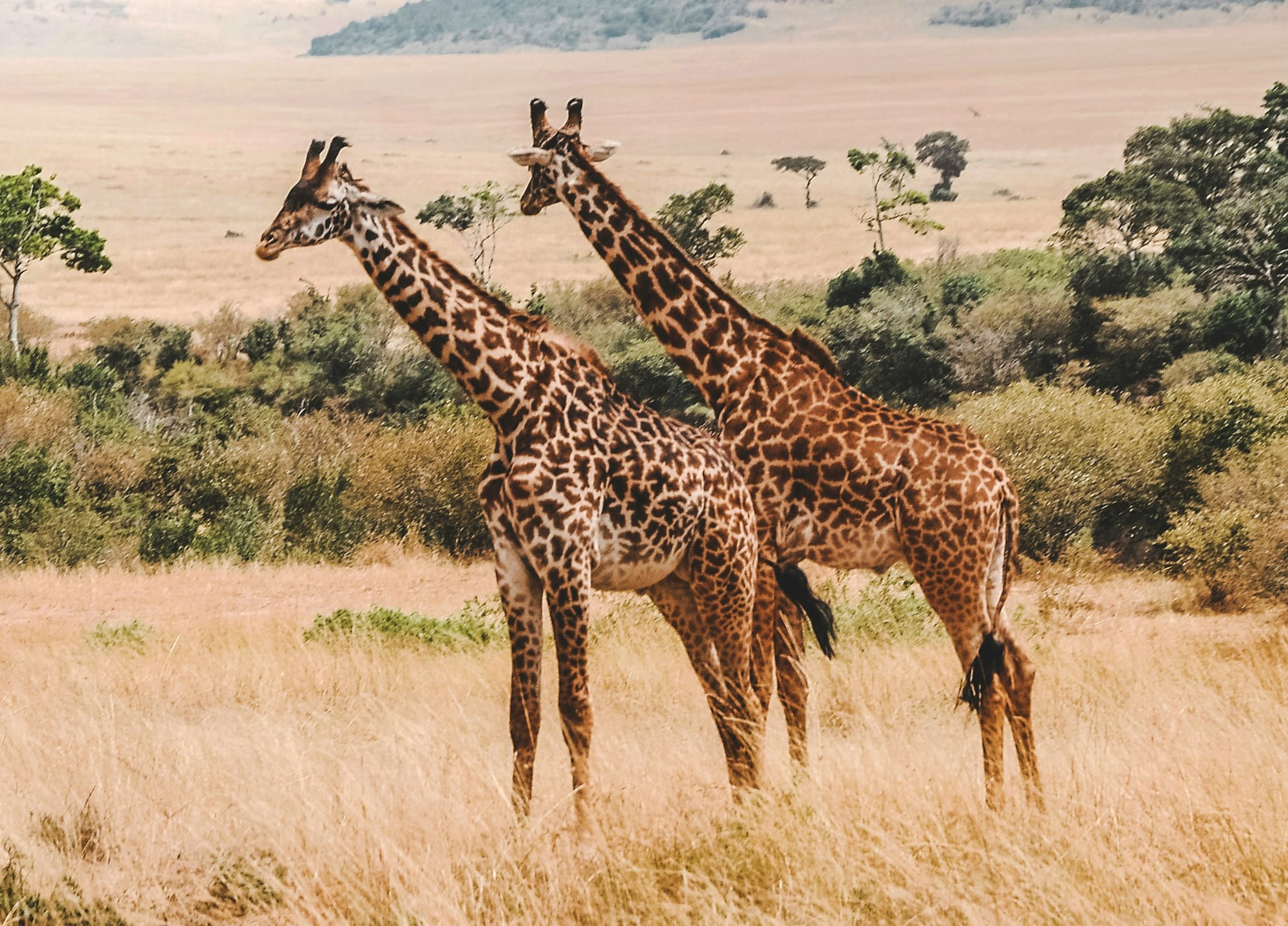
Two giraffes. Standing close together in the golden grass, necks crossed, turning to look at the vehicle with the mild curiosity of animals that have never been hunted here and know it. Behind them, the savanna stretches to the horizon — flat, vast, the kind of space that recalibrates your understanding of what space means.
Nobody speaks for a long time.
What You See
The Mara's wildlife density is, by any measure, remarkable.
The Big Five — lion, leopard, elephant, buffalo, rhino — are all present, though the rhino requires patience and luck. What surprises most first-time visitors is not the headline sightings but the abundance of everything else: the herds of zebra and wildebeest that stretch to the horizon during the Great Migration (July through October, and worth planning your trip around), the cheetahs hunting in the open grass, the hundreds of bird species that populate the riverine forests, the hyenas and jackals and bat-eared foxes that fill in the spaces between the larger dramas.
The Mara does not save its best for special occasions. Every drive is different. Every hour on the grass produces something worth seeing.
The Great Migration
If you can time your visit for the migration, do.
Between July and October, approximately two million wildebeest, zebra, and gazelle move north from the Serengeti in Tanzania into the Mara in Kenya, following the rains and the grass in one of the largest animal movements on Earth. The river crossings — when the herds commit to crossing the crocodile-filled Mara River in their thousands — are among the most dramatic wildlife spectacles anywhere on the planet.
They are also deeply, genuinely moving in a way that photographs do not fully capture. The scale of it. The noise. The fact that this has been happening, on this river, in this landscape, for longer than any human institution has existed.
It puts things in perspective. Most things, in the Mara, do.
Going Back
People who have been to the Mara tend to go back.
Not always immediately, not always soon — but the pull is consistent and well-documented among the people who know the place. There is something about having been somewhere that operates on its own terms, entirely indifferent to yours, that makes the ordinary world feel slightly provisional afterward.
You come back to your city, your schedule, your inbox. It all resumes. But somewhere in the back of the mind, there is a memory of two giraffes in golden light, and a silence so complete you could hear your own breathing, and a landscape that has been exactly this since before there was anyone to see it.
It tends to stay there.
Most people, eventually, go back.
The Maasai Mara National Reserve is open year-round. Peak season runs from July to October during the Great Migration. Independent guides and conservation-focused camps are available at a range of price points. Entry fees support local conservation and community programs.
