The Lioness Standard: What the Most Effective Leader in the Animal Kingdom Can Teach Us
She is not the largest animal in the savanna. Not the loudest. She doesn't have the mane, the roar, the iconic profile that has appeared on flags and logos for three thousand years. That is the male lion. He is impressive. She is the one who feeds the pride.




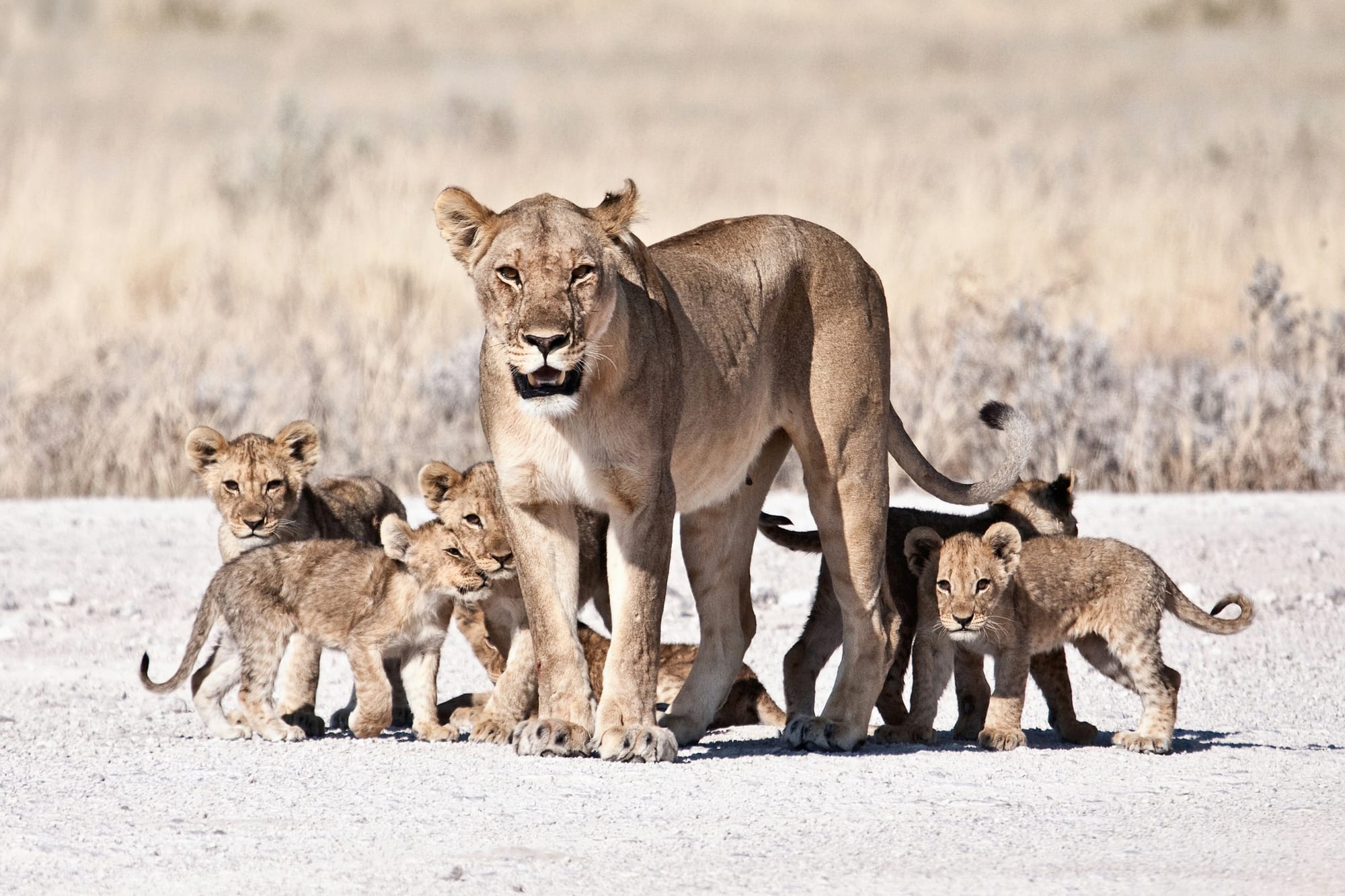
She is not the largest animal in the savanna. She is not the loudest. She does not have the mane that fills the frame of every wildlife documentary, the roar that carries five miles across the open plain, the iconic profile that has appeared on flags and crests and corporate logos for three thousand years.
That is the male lion. He is impressive. He is also, functionally, a secondary character in the actual operation of the pride.
The lioness is the one who feeds it.
Who Actually Runs the Pride
The popular image of lion society is male-dominated — the king of the jungle, the apex predator, the singular dominant figure whose authority structures everything below him.
The reality is considerably more interesting.
A lion pride is, in practice, run by its females. The core of any pride is a group of related lionesses — mothers, daughters, sisters, cousins — who have lived together, hunted together, and raised cubs together across years and sometimes decades. They establish the territory. They conduct the hunts that sustain the group. They make the collective decisions about when to move, when to defend, when to retreat. They raise not only their own cubs but often each other's, in a cooperative childcare arrangement that has no parallel among the other big cats.
The male lions — impressive, territorial, essential for protection against rival males — come and go. The pride's female core is its continuity.
She is standing in this photograph with four cubs clustered around her legs, looking directly into the camera with an expression that contains no performance. She is not posing. She is assessing. She is, in this moment, doing exactly what she does every moment: determining what the situation requires and preparing to respond to it.
Lead From the Front
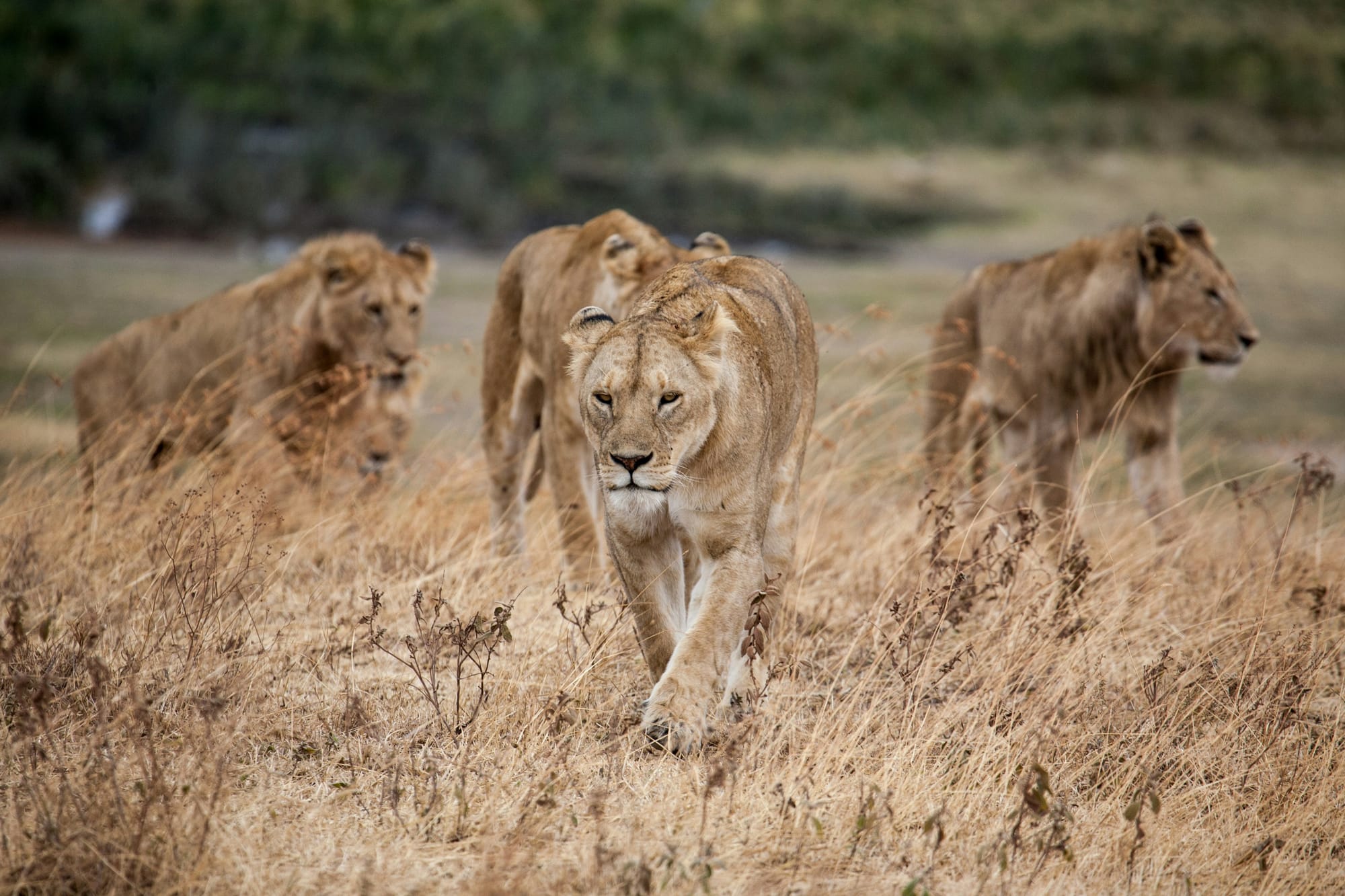
The lioness hunts at the front.
This is not metaphor. In cooperative hunts — where multiple lionesses coordinate to bring down prey significantly larger than any individual could manage alone — the most experienced hunters position themselves closest to the prey, in the most dangerous positions, where the risk of injury is highest and the margin for error is smallest.
Leadership, in lion society, is not a position of safety. It is a position of exposure. The most capable go first, take the most risk, absorb the most consequence. The less experienced learn by watching and by gradually taking on more of the burden as their skills develop.
The contrast with many human organizational structures — where leadership tends to insulate itself from the front-line risk while directing those with less power toward it — is worth sitting with.
The lioness doesn't send others into the difficult position. She occupies it.
Collective Over Individual
A single lioness can bring down prey up to twice her size. A group of lionesses can bring down prey ten times her size.
The cooperative hunting of lions is one of the more sophisticated examples of coordinated group action in the animal kingdom — involving approach angles, timing, role specialization, and an adaptive responsiveness to how the prey is behaving that requires each individual to be aware of what the others are doing while executing her own role.
There is no verbal communication during the hunt. There is no designated coordinator calling plays. There is something more fundamental: deep mutual knowledge, built over years of shared experience, that allows each individual to anticipate what the others will do and calibrate her own actions accordingly.
This is what genuine team cohesion looks like — not the product of a team-building exercise or a shared values document, but of enough shared difficulty, over enough time, that the group has developed a collective intelligence that exceeds the sum of its individual parts.
The human organizations that function this way — that have built the kind of trust and mutual knowledge that allows coordinated action without constant explicit communication — are rare, and they are recognizable by the quality of what they produce.
Protect What Matters
Four cubs. Around her legs. Looking at a world they don't yet know how to read.
The lioness's relationship to her cubs is not sentimental in the human sense. It is practical, complete, and absolute. She will hunt to feed them. She will fight — against hyenas, against rival lions, against threats that outweigh her significantly — to protect them. She will teach them, through the patient repetition of demonstrated behavior, everything they will need to survive without her.
And she will do all of this while continuing to fulfill her role in the pride — hunting, maintaining territory, participating in the collective functions that keep the group viable.
The leadership lesson here is not about sacrifice in the abstract. It is about the integration of care and competence — the understanding that protecting and developing the next generation is not separate from the work of leading, but continuous with it. That the most important thing a leader builds is not the quarterly result but the capability of the people coming after her.
Patience as Strategy
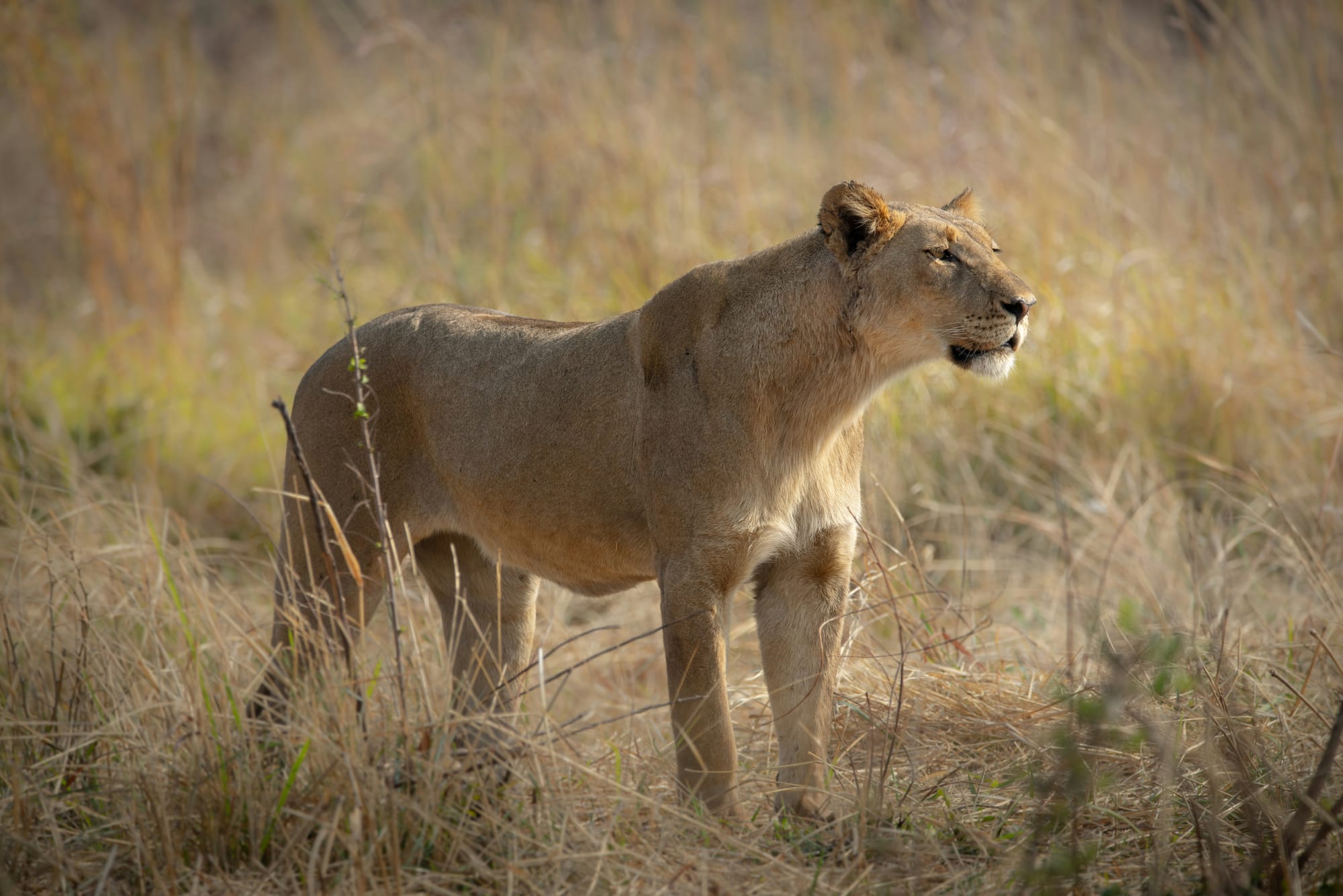
The lioness spends most of her time waiting.
This is the part that doesn't photograph well. The hours of stillness before the hunt — reading the herd, reading the wind, reading the terrain, waiting for the conditions that make success more likely than failure. The patience is not passive. It is an active process of information gathering and preparation, conducted with a discipline that the eventual explosive action makes easy to overlook.
Premature action, in a hunt, costs more than patience does. A poorly timed approach that alerts the prey means hours of reset, of repositioning, of waiting for another opportunity. The experienced hunter knows that the moment to act is specific — and that acting before it arrives is more costly than waiting for it.
This principle applies with uncomfortable directness to most of the situations in which human leaders act too early, driven by the pressure to be seen doing something rather than the discipline of waiting for the moment when doing something will actually work.
The savanna does not reward visible effort. It rewards results. And results, for the lioness, come from the patience to wait for the right moment and the decisiveness to commit fully when it arrives.
The Look
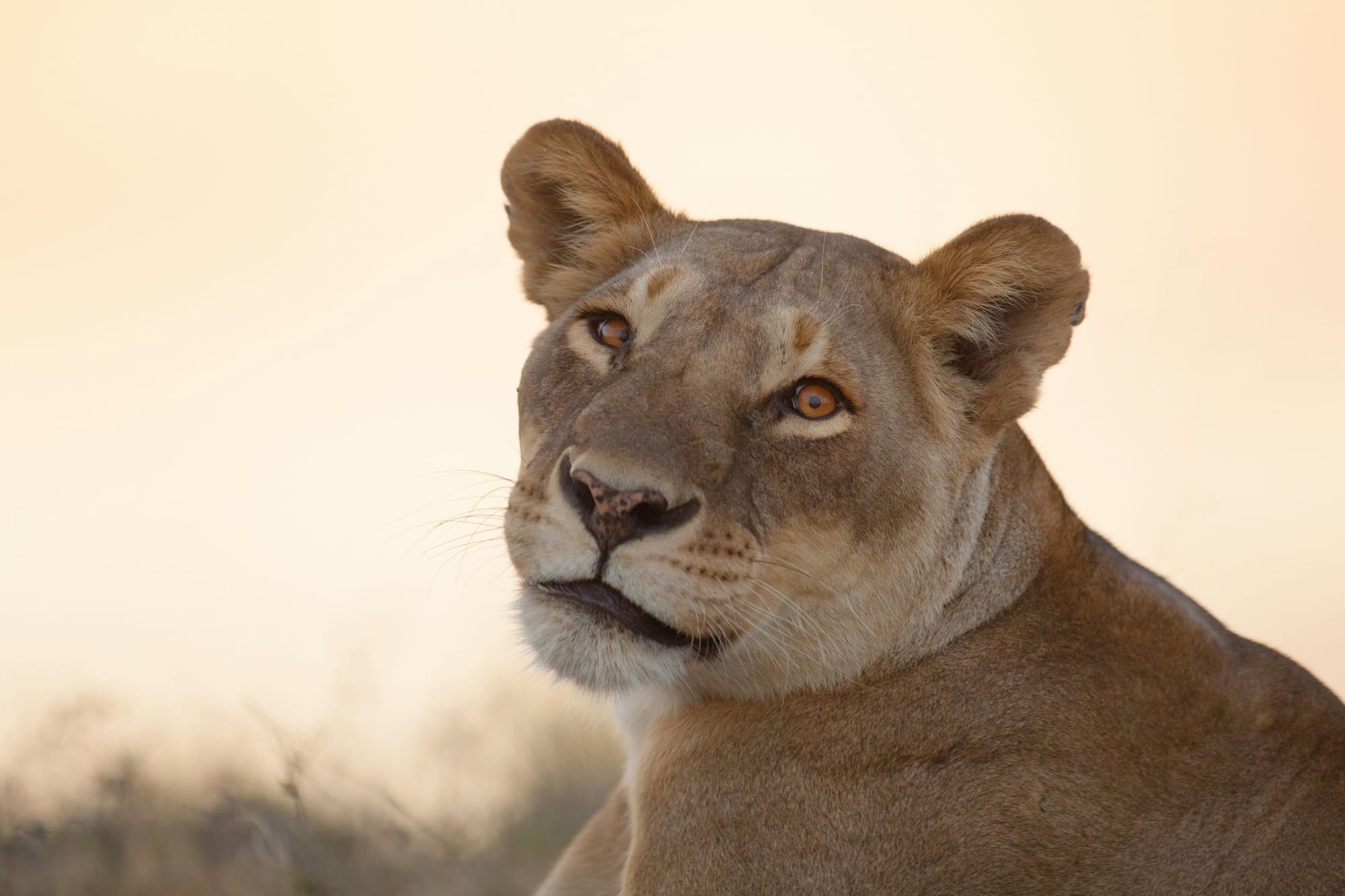
She is looking directly at the camera in this photograph.
Not with aggression. Not with fear. With the complete, unhurried attention of an apex predator who has assessed the situation and determined that the threat level is manageable. Her cubs are around her. Her posture is alert but not tense. She is present in the way that only animals — and very occasionally people — are fully present: without the internal commentary, without the performance of reaction, without anything except the actual situation and the capacity to respond to it.
That quality of presence — the ability to be where you are, fully, with the information that's actually available rather than the information you wish you had — is perhaps the most fundamental leadership quality the lioness demonstrates.
The cubs will grow into it. The pride depends on it. And the photograph, if you look at it long enough, offers it back to you as a standard.
Not the loudest. Not the largest. The most effective.
The lioness standard.
The African lion is currently classified as Vulnerable on the IUCN Red List. Lion populations have declined by approximately 43% over the past 21 years. Conservation organizations working on lion protection include Panthera, the Lion Recovery Fund, and the African Wildlife Foundation.
