The Room at the End of the Hall: What Life Inside an Elite Unit Actually Looks Like
The photograph doesn't show the training. Three figures in a ruined building, moving with coordinated quiet that looks like choreography. It is not choreography. It is thousands of hours of repetition so complete that the movements have stopped being decisions and become reflexes.

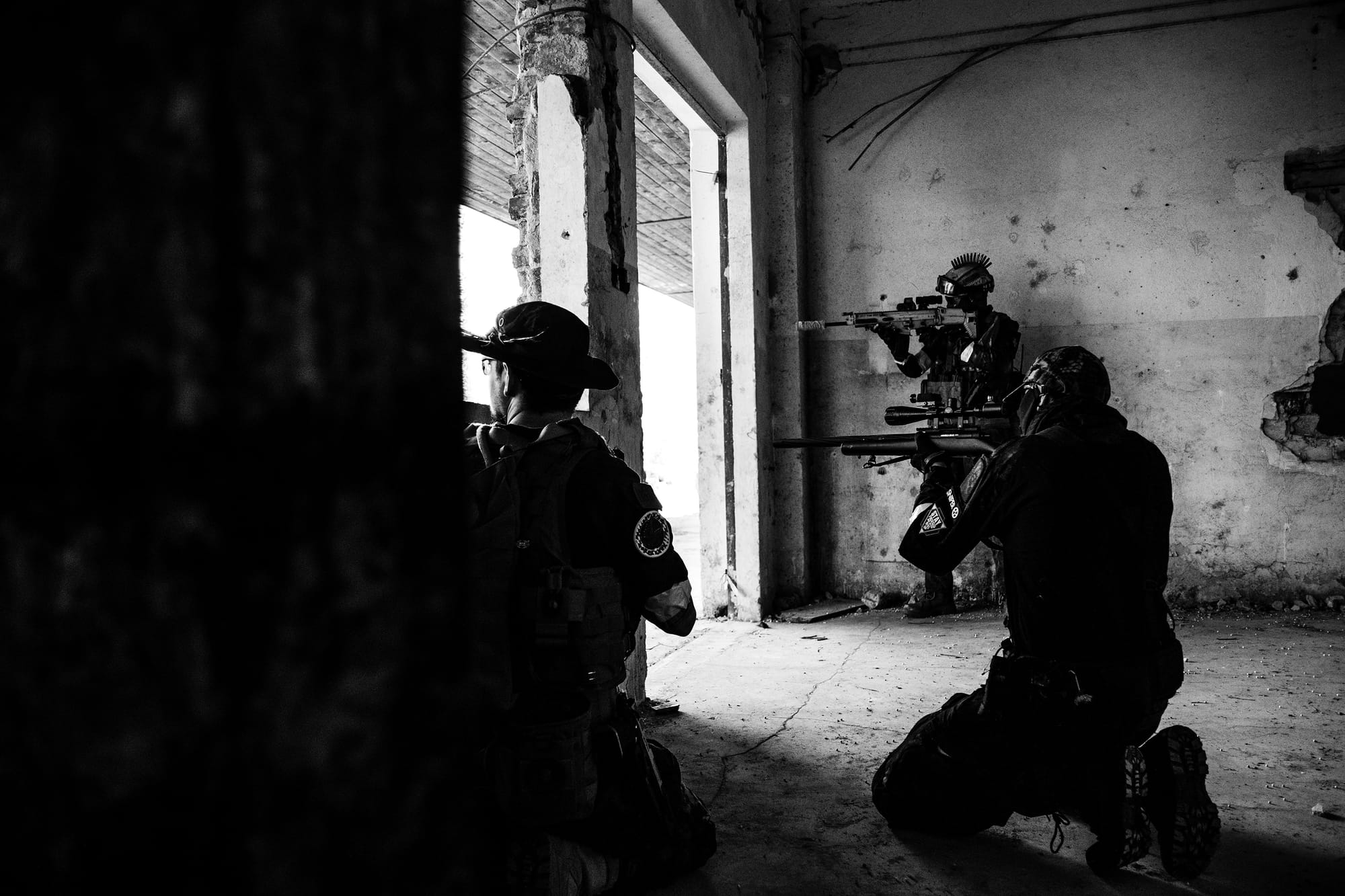
The photograph doesn't show the training.
Three figures in a ruined building, backlit by blown-out windows, rifles up, moving with the kind of coordinated quiet that looks, from the outside, like choreography. It is not choreography. It is the result of thousands of hours of repetition so complete that the movements have stopped being decisions and become reflexes — the body doing what the mind has drilled into it until conscious thought is no longer in the loop.
That process — the making of the kind of person who can function in that room — is the story that the photograph doesn't tell. It is also, for the people who have lived it, the more interesting one.
Selection
Every elite military unit in the world begins with selection — a process designed not to teach candidates anything, but to find out what they already are.
The physical requirements are severe. But physical fitness, every selection cadre will tell you, is not what selection is really testing. It is a prerequisite, not the point. The candidates who fail selection are rarely the ones who weren't fit enough. They are the ones who quit.
The distinction matters. Selection is, in large part, an extended exercise in manufacturing circumstances under which quitting seems like the rational choice — and then watching to see who quits anyway. Sleep deprivation, caloric restriction, physical exhaustion layered over days without adequate recovery, tasks that seem arbitrary and are not, pressure applied in patterns designed to reveal how a person behaves when the rational mind has been ground down to nothing.
What remains, when everything comfortable has been stripped away, is the person underneath.
That person is either someone the unit can trust their life to, or they are not. Selection finds out which.
The Team
The popular image of the elite operator is a solitary one — the lone specialist, self-sufficient and lethal, operating beyond the reach of conventional support.
The reality is almost exactly the opposite.
The defining characteristic of elite units is not individual capability. It is team cohesion — the degree to which a small group of people can function as a single organism under conditions that would fragment less integrated teams. Individual excellence is the entry requirement. What the unit develops, through years of shared training and operational experience, is something that transcends individual performance.
Trust, specifically. The kind of trust that is not a feeling but a structural fact — built on evidence accumulated over enough shared difficulty that it has become unconditional. In a room at the end of a hall, in a building that may or may not hold a threat behind every door, that trust is not an abstraction. It is the operational foundation that everything else rests on.
"You stop thinking about yourself," one former special operations veteran described it. "Not because you've become selfless in some noble sense. Because your survival and your teammates' survival are the same thing. The distinction between looking out for yourself and looking out for them disappears."
The Hours
The public-facing image of elite military service is defined by its high-intensity moments — the operation, the mission, the photograph like the one at the top of this article.
The reality is defined by its ordinary ones.
The hours in the gym before dawn. The range time, thousands of rounds, drilling the same movements until they are automatic. The classroom work — languages, regional geography, intelligence analysis, the specific knowledge required to operate in specific environments. The equipment maintenance, meticulous and continuous. The physical recovery, managed with the seriousness of professional athletes because the body is, functionally, the primary piece of equipment.
Between deployments, the preparation for deployments is the job. It is unglamorous, repetitive, and essential. The three seconds in the room at the end of the hall are possible because of the thousands of hours that preceded them. The ratio of preparation to operation is, in elite units, overwhelmingly weighted toward preparation.
This is the part that doesn't get photographed.
The Cost
Elite military service extracts a price that is not always visible at the time it is being paid.
The physical toll is the most legible — injuries accumulated over years of high-intensity training and operational stress, often managed through rather than recovered from, because the culture and the operational tempo rarely accommodate the time that proper recovery requires. The knees and shoulders and lower backs of veterans in their forties tell a story that the fitness of their thirties didn't predict.
The psychological toll is more complex and less discussed.
The hypervigilance that is adaptive in a combat environment — the constant environmental assessment, the attention to exits and threats and the behavior of people in the immediate vicinity — does not switch off cleanly when the environment changes. The emotional compartmentalization that makes it possible to function in high-lethality situations can, over time, affect the capacity for the kind of open emotional engagement that relationships require.
The transition out of elite service — which comes for everyone, eventually — involves reintegrating into a civilian world that operates at a different pace, with different stakes, where the skills that defined a career are largely non-transferable and the identity built around them requires reconstruction.
This transition is, for many veterans, the hardest thing they have done.
What the Room Requires
Back in the photograph: three figures, one room, rifles up, backlight from the windows.
What the image captures, if you know what you're looking at, is not aggression. It is concentration — the complete, disciplined focusing of trained attention on a specific operational problem. Each figure is aware of their sector, their teammates' positions, the entry points, the angles. The coordination visible in their positioning was not discussed in that moment. It was established through training so thorough that it requires no discussion.
This is what elite units produce: people who can function at the highest level of their training in conditions specifically designed to make that impossible.
The room at the end of the hall is where that investment is tested.
Everything before it is why it holds.
This article draws on publicly available accounts from veterans of special operations units across multiple nations. No classified information was used or sought.
