The Face in the Mud: What We Lose When War Becomes Abstract
The person in the mud did not make the decision that put him there. He was sent — by institutions, by governments, by people who will not be lying in this mud. Before any decision to go to war, this face should be in the room. Not as a symbol. As a reality.


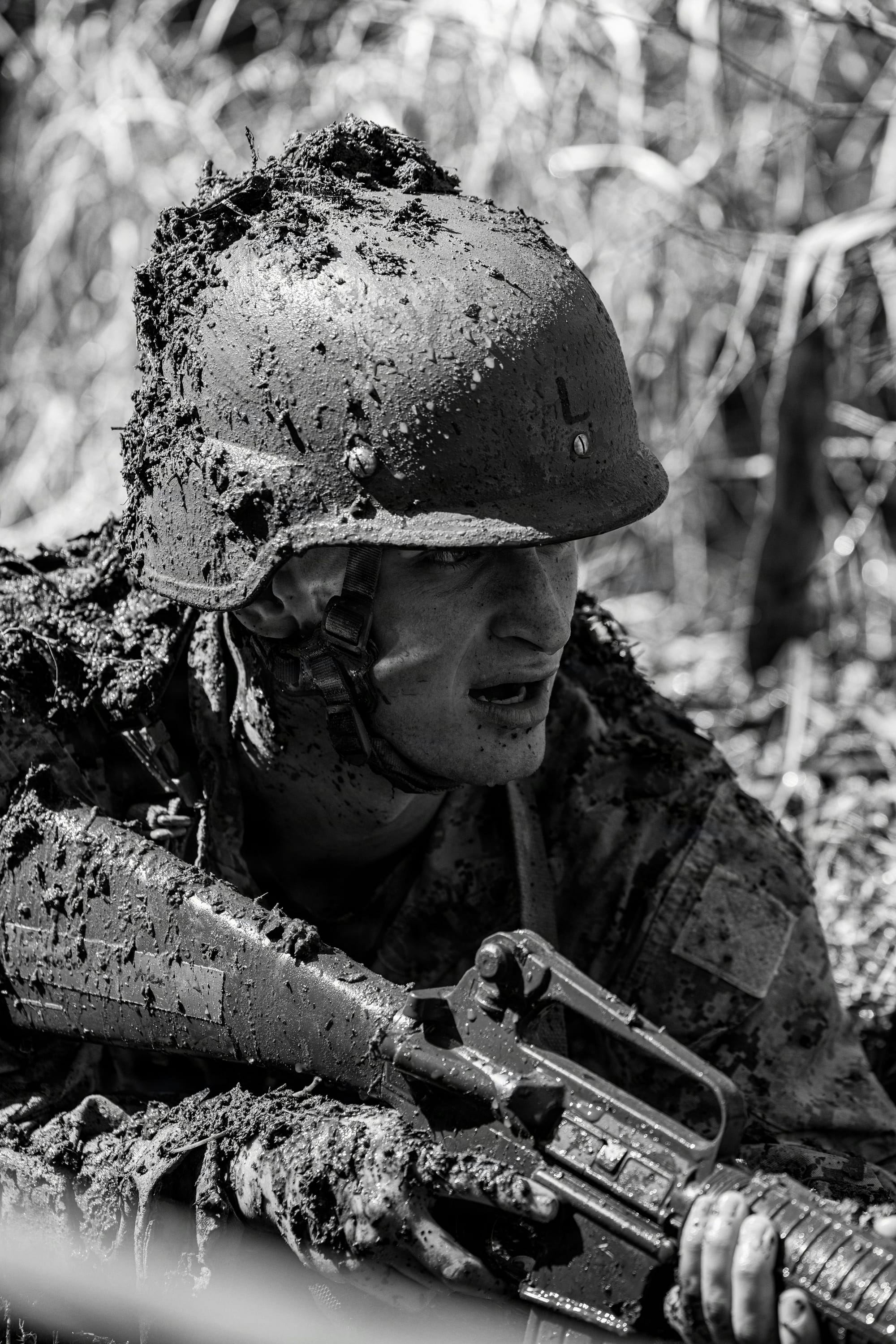
Look at the photograph.
Not past it. Not through it. At it.
The mud is everywhere — helmet, face, hands, rifle, uniform — layered so thick it has become its own texture, obscuring the details beneath until the man and the earth are almost the same thing. His mouth is slightly open. His eyes are focused on something outside the frame, something we cannot see, something that has his complete and total attention in the way that only immediate danger commands.
He is not a symbol. He is not a statistic. He is a person, right now, in this moment, doing something that most of us will never be asked to do.
That distinction matters enormously. And we keep forgetting it.
The Abstraction Problem
War, as most people experience it, is abstract.
It is numbers in a news ticker. It is maps with colored overlays. It is press briefings delivered in careful language designed to convey information while minimizing the visceral reality of what that information represents. It is geopolitical analysis, strategic interest, historical context, the language of institutions describing events that happen to human beings.
All of that framing serves a purpose. Understanding war at the macro level — its causes, its consequences, its patterns across history — requires the kind of distance that abstractions provide. You cannot analyze what you cannot step back from.
But somewhere in the accumulation of distance, something essential gets lost.
The person in the mud.
What the Camera Does
Combat photography exists, at its best, to close that distance.
Not to glorify. Not to recruit. Not to make war look exciting or heroic or cinematic — though it has been used for all of those purposes, and the distinction between documentary intent and propaganda effect is one that honest practitioners of the form spend careers navigating.
At its best, combat photography does something simpler and more important: it makes the abstract specific. It takes the number — the casualty figure, the deployment statistic, the strategic update — and gives it a face. A face covered in mud, in this case. A face with an expression that no press briefing language can replicate.
The great war photographers — from the mud of the Western Front to the jungles of Vietnam to the streets of contemporary conflict zones — understood that their job was not to document battles. It was to document people inside battles. The difference is everything.
The Cost of Looking Away
There is a reason that the most confronting images of war are frequently suppressed, restricted, debated.
It is not only about protecting the privacy of the wounded or the dignity of the dead, though those are legitimate concerns. It is also — and this is the part that deserves more honest examination — because graphic reality changes minds. Because the face in the mud makes the decision to go to war harder than the map with the colored overlay does.
Governments have understood this for as long as governments have fought wars. The management of wartime imagery is as old as wartime imagery itself. What you are allowed to see shapes what you are willing to support. The people who make decisions about war have, historically, been very aware of this — and have managed public access to graphic reality accordingly.
This is not a conspiracy theory. It is documented policy, openly discussed by the institutions that practice it.
The question it raises is one that democratic societies have not answered satisfactorily: if the people who must ultimately sanction war through their political support are shielded from its reality, how informed is their consent?
The Individual Inside the Uniform
Here is the thing that the photograph makes impossible to ignore: the person inside the uniform did not make the decision that put him there.
He was sent. By institutions, by governments, by the accumulated weight of decisions made in rooms he was not invited into, by people who will not be lying in this mud. He is the implementation of someone else's policy. The human cost of someone else's calculation.
That is not an argument against military service, which involves forms of courage and commitment that deserve genuine respect. It is an argument for being honest about what we are asking of people when we send them to war — and for holding the decision-makers to an accounting that is proportional to that ask.
The face in the mud should be in the room when those decisions are made. Not literally — but as a present reality, not an abstracted consequence. Before the vote, before the briefing, before the strategic calculation: this face. This mud. This person's complete and total attention fixed on something none of us can see.
What Honest Remembrance Requires
We build monuments to the fallen. We hold ceremonies. We say the words.
These things matter. Collective memory and public mourning are not nothing — they are part of how societies process collective trauma, and the alternative to remembrance is a forgetting that makes repetition more likely.
But monuments are, by nature, abstracting. They turn the specific — this person, this face, this moment in the mud — into the general: the soldier, the sacrifice, the fallen. The transformation is understandable. It is also, if it becomes the only mode of remembrance, a way of keeping the reality at a distance.
Honest remembrance requires something harder. It requires looking at the photograph. It requires sitting with the specific reality of what we asked of this person — not the noble version, not the edited version, but the version with the mud and the open mouth and the eyes fixed on something terrible just outside the frame.
It requires, in other words, refusing the abstraction.
The Face
He doesn't know we're looking at him.
Wherever he is in the moment this image was taken, he is entirely occupied by something else. He is in it — whatever it is — completely. The mud is real. The rifle is real. The thing he's looking at is real.
We owe him, at minimum, the honesty of looking back.
Opinions expressed in this article are those of the author and do not represent the editorial position of this publication.
