The Light Through the Blinds: What Getting Older Actually Teaches You
There is a quality to the face of someone who has lived long enough to stop pretending. Not bitter, not resigned — something quieter. A stillness that comes from having been through enough that the performance of certainty no longer seems worth the effort.

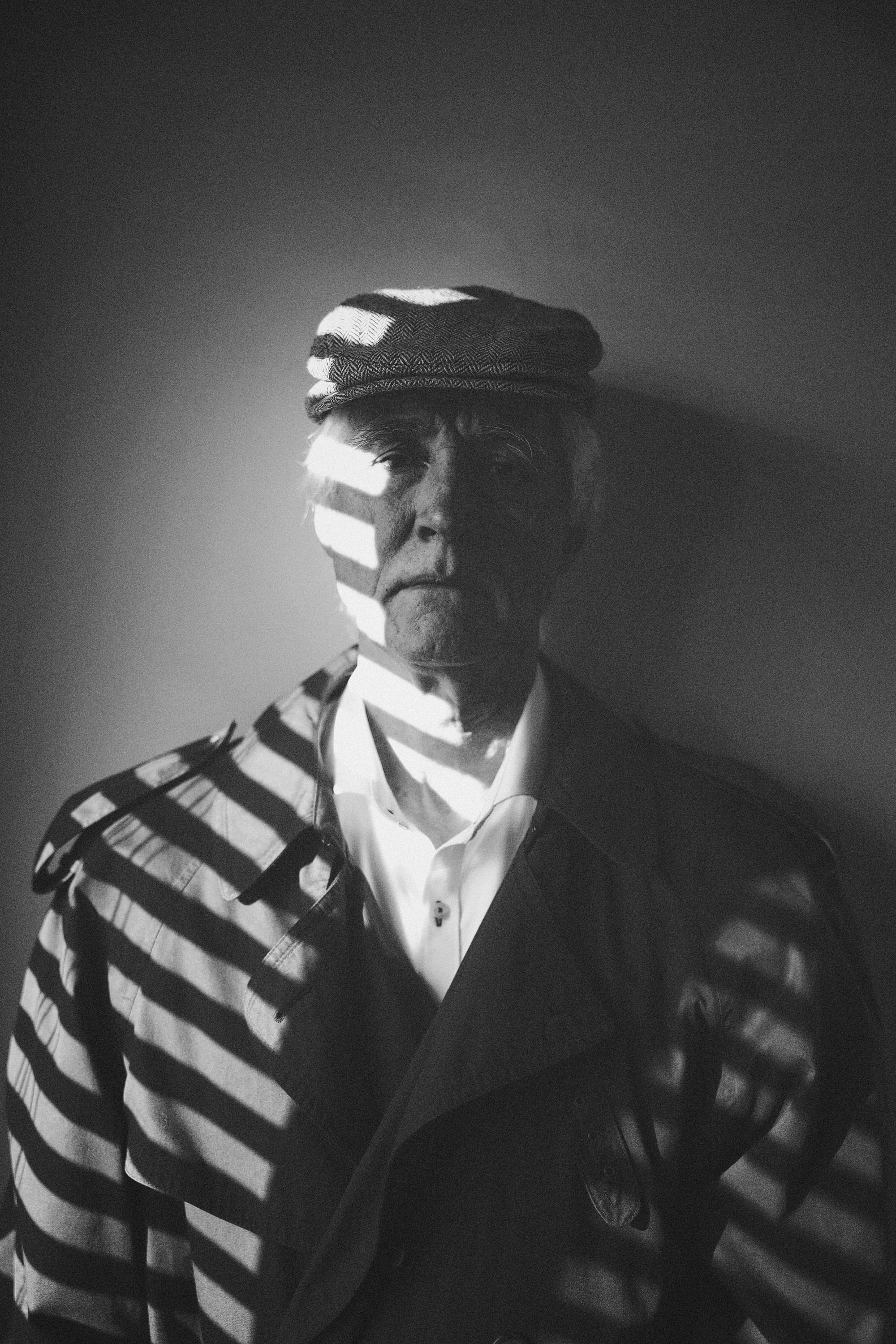
There is a particular quality to the face of someone who has lived long enough to stop pretending.
Not bitter. Not resigned. Something quieter and harder to name — a stillness that comes from having been through enough that the performance of certainty no longer seems worth the effort. The face in the photograph has it. The flat cap, the coat, the striped light falling across him at an angle that makes the shadows as present as the man himself.
He is not looking at you. He is looking at something further away. Something you can't see yet.
That, more than anything, is what age gives you: a longer view.
The Things Youth Cannot Buy
There is a version of wisdom that our culture pretends can be shortcut.
Read the right books. Find the right mentor. Optimize your habits, curate your influences, compress the learning curve. The self-improvement industry is built, in large part, on the promise that the lessons of experience can be acquired without the experience itself.
Some of them can. Knowledge transfers. Skills transfer. Frameworks, strategies, and mental models can be borrowed from people who developed them the hard way and applied by people who didn't.
But the deepest things that age teaches — the ones written into the face of the man in the photograph — don't transfer that way. They have to be lived. They arrive not through reading or listening but through the accumulated weight of time, loss, error, and the slow, humbling process of finding out which of your beliefs about yourself and the world were true.
What the Years Actually Deliver
The first thing age teaches is proportion.
When you are young, everything is urgent. Every setback is a crisis. Every rejection is definitive. Every opportunity missed feels like the last one. The emotional weather of youth is intense precisely because there is no long track record to refer to — no accumulated evidence that this too, like every other thing that felt catastrophic, will eventually become just another thing that happened.
Age provides that evidence. Not as consolation, but as data. The person who has lived through enough hard seasons knows, in their bones in a way that cannot be fully communicated to someone who hasn't, that the current difficulty is not the final word. That the view changes. That what looks like an ending from inside it frequently turns out to be something else entirely from further down the road.
This is not optimism. It is perspective. There is a difference.
The second thing age teaches is selectivity.
Time, experienced as finite rather than theoretical, clarifies priorities with a ruthlessness that no productivity system can replicate. The older people I have spoken to — the ones who seem most at peace with where they are — share a quality of having shed things. Not dramatically, not all at once, but steadily: obligations taken on out of obligation, relationships maintained out of habit, ambitions inherited from other people's definitions of success.
What remains, after the shedding, is the actual list. The things that genuinely matter to this specific person, in this specific life. It is almost always shorter than the list they were working from at thirty.
The third thing age teaches is the value of ordinary days.
The young tend to orient toward the exceptional — the milestone, the achievement, the peak experience. Age shifts this orientation, gradually and then decisively, toward the ordinary. The morning coffee. The familiar walk. The conversation with someone you have known long enough that silence between you is comfortable rather than awkward.
This is not a settling for less. It is a recognition of what the extraordinary moments are actually made of — not the events themselves, but the accumulation of ordinary time that gives them their weight and meaning. The dinner that mattered because of the years of dinners before it. The view that moved you because you have been looking at views long enough to know what makes one worth stopping for.
The Shadows on the Wall
The striped light in the photograph falls across the man in a pattern that looks almost like bars — but softer. More like the light through venetian blinds on a late afternoon, the kind of light that suggests a room where time moves differently than it does outside.
He has earned that light. The shadows it casts are part of the portrait, not subtracted from it. The lines on his face are part of the portrait. The heaviness of his posture — not defeated, just settled, the posture of someone who has stopped standing up straight for other people's benefit — is part of the portrait.
Age is not the absence of youth. It is the presence of everything that came after.
What the Longer View Shows
Here is what the people at the far end of the road tend to say, when asked what they know now that they wish they had known earlier.
That the things they worried about most were rarely the things that mattered most. That the time spent managing other people's opinions of them was, in retrospect, the least well-spent time of their lives. That the relationships they invested in — really invested in, with attention and presence and the willingness to be known — returned more than anything else they did. That the body, ignored for decades, eventually presents a bill that cannot be deferred. That the work they are proudest of is almost never the work that was most celebrated at the time.
And, almost universally: that it went faster than they expected. That the decades between thirty and seventy feel, from the inside, like a long afternoon. That the urgency of youth — the sense of endless time to do the things you mean to do — was the most costly illusion of all.
The Gift Nobody Wants Until They Have It
Age is not a destination most people rush toward.
The culture we live in treats it as a problem to be managed — delayed, disguised, optimized away. The anti-aging industry is one of the largest on Earth. The premium placed on youth, in almost every domain of public life, is so pervasive that it has become background noise.
But the man in the photograph is not managing anything. He is simply present in his age the way the light is present in the room — unhurried, indifferent to whether it is admired, falling where it falls.
There is something in that worth learning before you have lived long enough to learn it naturally.
The longer view is available, in fragments, right now. The people who have it are often sitting in rooms with afternoon light falling across them, looking at something further away than you can currently see.
Go talk to them. While there is still time.
The most valuable conversations of your life may be with the oldest people you know. Ask them what they would do differently. Then ask them what they wouldn't change.
