The Ladder Out of the Trench: What War Costs and Who Pays It
War's real invoice is never counted in any ledger. It lives in the body of a man who flinches at a car backfiring twenty years later. It lives in the silence of a family that never spoke about what came home — because what came home wasn't entirely who had left.

The Ladder Out of the Trench: What War Costs and Who Pays It
By Staff Writer | June 3, 2026 | Opinion
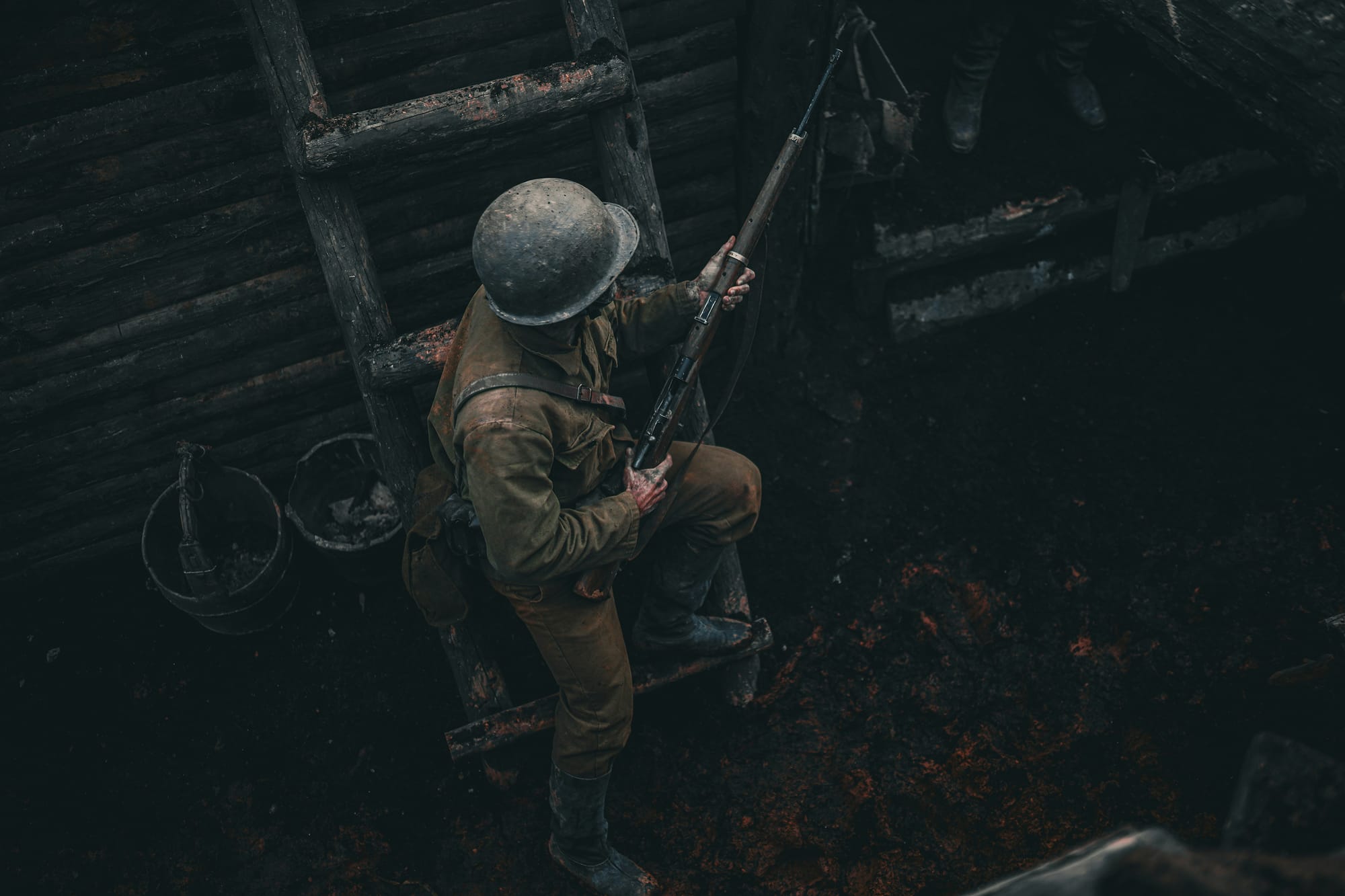
Look at the photograph long enough and you stop seeing a soldier.
You see a person. Someone's son. Someone who, a few years earlier, had a name that people called casually — across a dinner table, from the bottom of a staircase, in the easy way that names get used when there's no urgency to them. Now he's in a trench, rifle in hand, climbing toward something that may kill him. The mud on his uniform has been there long enough to dry. He is not panicking. That, somehow, is the most disturbing part.
He has gotten used to this.
The Cost Nobody Counts Correctly
War has always had an official price tag.
Governments count it in casualties and kilometers. Historians count it in dates and treaties. Defense budgets count it in procurement contracts and logistics chains. These are real numbers, and they matter — but they are also, in a fundamental sense, the wrong unit of measurement.
The true cost of war is not counted in any ledger. It lives in the body of a man who flinches at a car backfiring twenty years after the last shot. It lives in the silence of a family that never spoke about what happened because the person who came home was not entirely the person who left. It lives in the villages that were rebuilt but never quite recovered, in the soil that grew strange things for a generation after the shells stopped falling.
War's real invoice is paid slowly, in installments, by people who never signed anything.
What It Does to the Person Inside the Uniform
There is a phenomenon that military psychologists now understand with considerable precision, even if the culture around it remains uncomfortable.
The human mind is not designed for sustained exposure to violence, death, and the constant proximity of one's own erasure. It adapts — because it must — but adaptation is not the same as survival intact. The coping mechanisms that keep a soldier functional in a trench can become the source of profound suffering the moment he tries to live an ordinary life again.
Hypervigilance that was life-saving becomes exhausting. Emotional detachment that was protective becomes isolating. The capacity to switch off empathy — necessary when empathy would be paralyzing — doesn't always switch back on cleanly.
We have given this a clinical name. We have built institutions around it. But we have not, as a culture, fully reckoned with the fact that these are not disorders that soldiers arrive with. They are injuries that war gives them. There is a meaningful difference, and the distinction matters enormously for how we think about the people who carry them.
The Generation That Comes After
The damage does not stop with the person who was there.
Research into intergenerational trauma has made increasingly clear what families of veterans have understood intuitively for decades: that the psychological wounds of war do not stay contained within the individual who sustained them. They move through families like a slow current — shaping parenting styles, attachment patterns, the way conflict is handled or avoided, the stories that get told and the ones that never do.
Children grow up in the emotional weather of their parents' unprocessed experience. They inherit fears they cannot name and silences they cannot explain. By the time the connection is understood, if it ever is, another generation has already been shaped by it.
The soldier climbing the ladder out of the trench carries more than a rifle. He carries a future that will be defined, in ways he cannot yet imagine, by what happens in the next few minutes. So will his children. So, perhaps, will theirs.
The Seduction of Necessity
None of this is an argument that war has never been necessary. History is complicated, and the honest version of it includes moments where the alternative to fighting was something worse.
But necessity, even when genuine, does not cancel cost. The two things exist simultaneously — and the habit of emphasizing necessity while minimizing cost is one of the ways that wars keep happening.
When we aestheticize combat, when we build cultural narratives around glory and sacrifice without equal time on devastation and waste, we make the decision to go to war easier than it should be. We make it easier for the people who make that decision — who are rarely the ones climbing the ladder — to make it again.
The photograph is not glorious. The mud is not glorious. The fact that the man in it has normalized climbing into rifle fire is not glorious.
It is a tragedy that learned to look routine.
What We Owe the People in the Photograph
At minimum, honesty.
Not the sanitized version of war that ends with parades and monuments — though monuments have their place. The full version. The one that includes the trench and the mud and the forty years of bad dreams and the children who grew up wondering why their father went somewhere unreachable when the room got loud.
We owe it to every person who has ever climbed that ladder to look clearly at what we are asking of them, what it costs them, and what it costs the people who love them.
And we owe it to ourselves to remember that the decision to send people up that ladder is always, without exception, a choice — and that choices of that magnitude deserve more than the language of necessity and glory.
They deserve the full weight of what they actually are.
Opinions expressed in this article are those of the author and do not represent the editorial position of this publication.
