The Blade and the Strip: Why Ancient Sports Still Have Something Modern Life Doesn't
The lunge takes less than a second. The fencer on the receiving end — if they're good enough — saw it coming. Not the attack itself, but the intention behind it. A micro-shift in weight, a change in blade angle, a barely perceptible breath. They read the person. In 200 milliseconds.

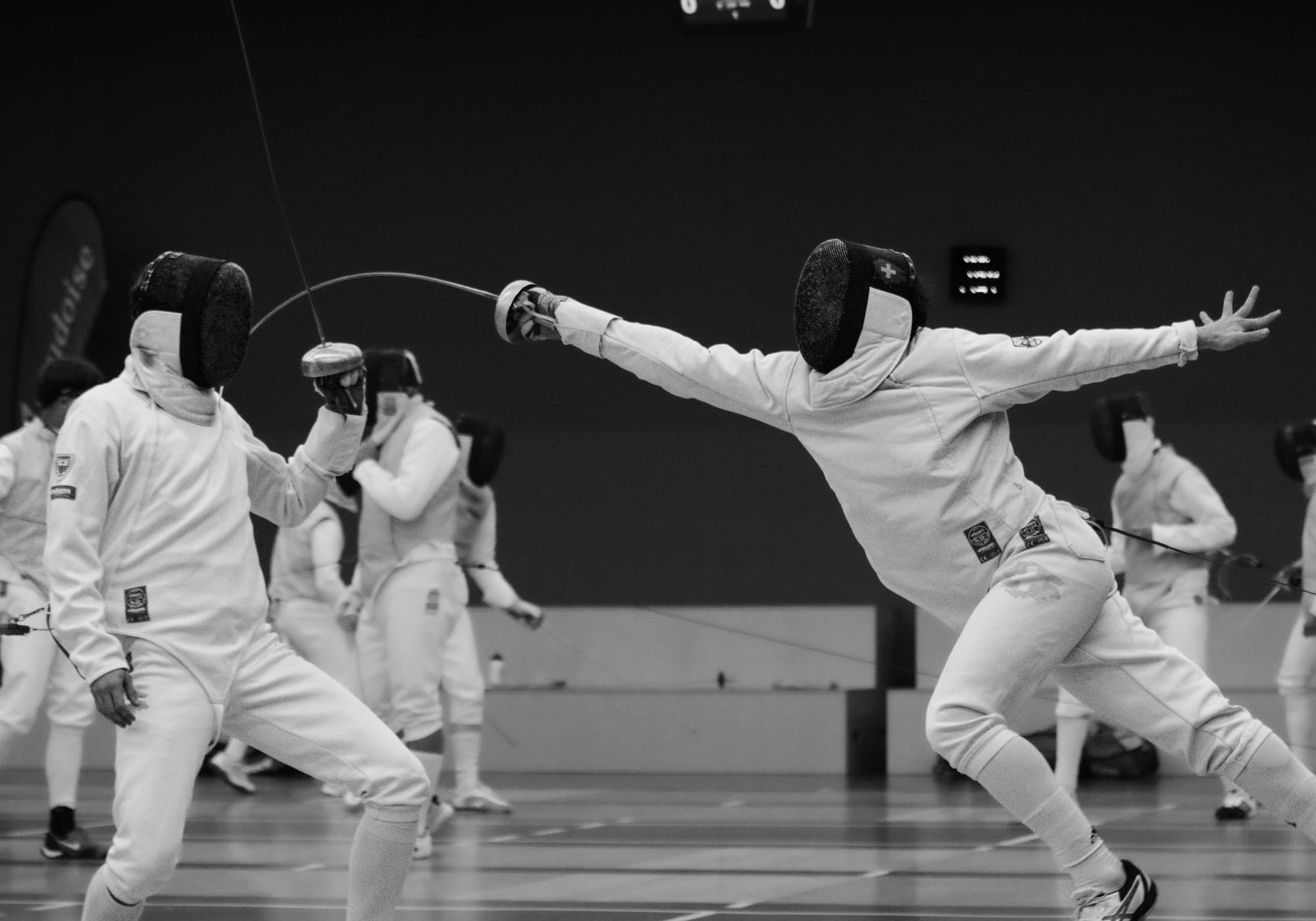
The lunge takes less than a second.
From the en garde position — weight balanced, blade extended, every muscle in a state of controlled readiness — the attack is a single explosive movement: front foot forward, rear leg driving, arm extending, point arriving at the target before the opponent's reaction time has a chance to close the gap. The entire sequence, from decision to contact, happens in approximately 200 milliseconds.
The human eye cannot fully process it. The scoring system requires electronic sensors to confirm what happened. And yet the fencer on the receiving end — if they're good enough — saw it coming. Not the lunge itself, but the intention behind it. The slight shift in weight, the micro-change in blade angle, the barely perceptible alteration in breathing that preceded it.
They read the person. In two hundred milliseconds. Under competitive pressure. With a weapon pointed at them.
This is what ancient sports preserve that modern life struggles to replicate.
What We Mean by Ancient
Fencing, in its competitive form, is a 19th-century codification of sword fighting traditions that stretch back millennia.
The weapons — foil, épée, sabre — are descendants of the dueling and military swords that shaped European history. The rules, the scoring systems, the competitive format were developed to make lethal skills safe enough to practice as sport. The white uniform, the mask, the strip of floor — these are the frame that civilization placed around something that was, for most of human history, a survival skill.
The same is true of wrestling, which appears in Egyptian tomb paintings from 2000 BC and in the ancient Olympics, and which continues today in forms that would be recognizable to those earliest practitioners. Of archery, of rowing, of the throwing events that began as training for combat and hunting. Of boxing, documented in ancient Greece and Mesopotamia, still practiced in gyms that haven't changed their essential character in a century.
These sports survived not because they were preserved in amber but because they kept being useful — because the skills and qualities they develop are not period-specific. They are human.
What the Strip Teaches That the Screen Cannot
There is a growing body of research on what is lost when physical, embodied, face-to-face competition is replaced by its digital equivalents — and the losses are not trivial.
The fencing strip is a masterclass in reading another human being in real time. Not their words, not their social media presence, not the curated version of themselves they choose to present — but their body. The way they hold tension. The tells that precede action. The difference between confidence and aggression, between patience and hesitation, between a feint designed to provoke a reaction and a genuine attack.
This is a skill that most modern environments — mediated by screens, structured by text, optimized for asynchronous communication — actively atrophy. We have become extraordinarily sophisticated at managing our digital self-presentation. We have, in the same period, had fewer opportunities to develop the older, deeper literacy of reading a person in the room.
The strip gives that back. It is unmediated, immediate, and honest in a way that most contemporary social interaction is not. You cannot bluff a good fencer for long. The body tells the truth that the face is trying to hide.
The Weight of History
There is something else that ancient sports carry that newer ones cannot: the weight of continuity.
When a fencer steps onto the strip, they are participating in a practice that connects them — through an unbroken chain of teachers and students, of technique passed from generation to generation — to every person who has ever picked up a blade in earnest. The lunge they are executing is structurally the same lunge that was executed in dueling academies in 18th-century Paris, on military training grounds in Renaissance Italy, in whatever form it took before the codification that gave it its current shape.
This is not nostalgia. It is inheritance. And inheritance, in a culture that prizes novelty above almost everything else, is undervalued to the point of being actively suspicious of.
Ancient sports are one of the places where the inheritance is still intact — where what was learned by people who are long dead is still being practiced, still being refined, still being passed forward. The student who earns a touch against their teacher is continuing something. The chain holds.
The Argument Against Obsolescence
The standard case against ancient sports is an implicit one: that skills developed for contexts that no longer exist — sword fighting, archery, wrestling — have no practical application in contemporary life and therefore no particular claim on our attention.
This argument mistakes the point.
The practical application of fencing is not self-defense with a foil. The practical application of fencing is everything the practice develops in the person doing it: the decision-making speed, the physical intelligence, the capacity to read and respond to another human being in real time, the discipline of a practice that rewards only genuine competence and cannot be shortcut.
These qualities transfer. They transfer to surgery and to negotiation and to leadership and to any domain that requires fast, accurate judgment under pressure. The ancient sport is a vehicle for developing human capacities that are not ancient at all — that are as necessary now as they have ever been.
The blade is three feet long. What it trains is not.
The Lunge, Again
Back to the strip. Two fencers, one moment, a decision made in the body before the mind has finished forming it.
The one who lands the touch read something the other didn't know they were showing. Acted on information that arrived faster than language. Committed fully to a movement that, if they read it wrong, would leave them completely exposed.
This is what ancient sports still have to teach.
Not how to fight. How to be present, perceptive, decisive, and fully committed — in a world that increasingly rewards the opposite of all of those things.
The strip is still there. The practice is still available.
The blade is waiting.
Opinions expressed in this article are those of the author and do not represent the editorial position of this publication.
