Still Standing: What 900-Year-Old Dead Trees in the Namib Can Teach Us About Endurance
They died nine hundred years ago. The water disappeared, the desert took everything, and the trees of Deadvlei have been dead ever since. But they never fell. And nine centuries later, they are still the most enduring things in the landscape.

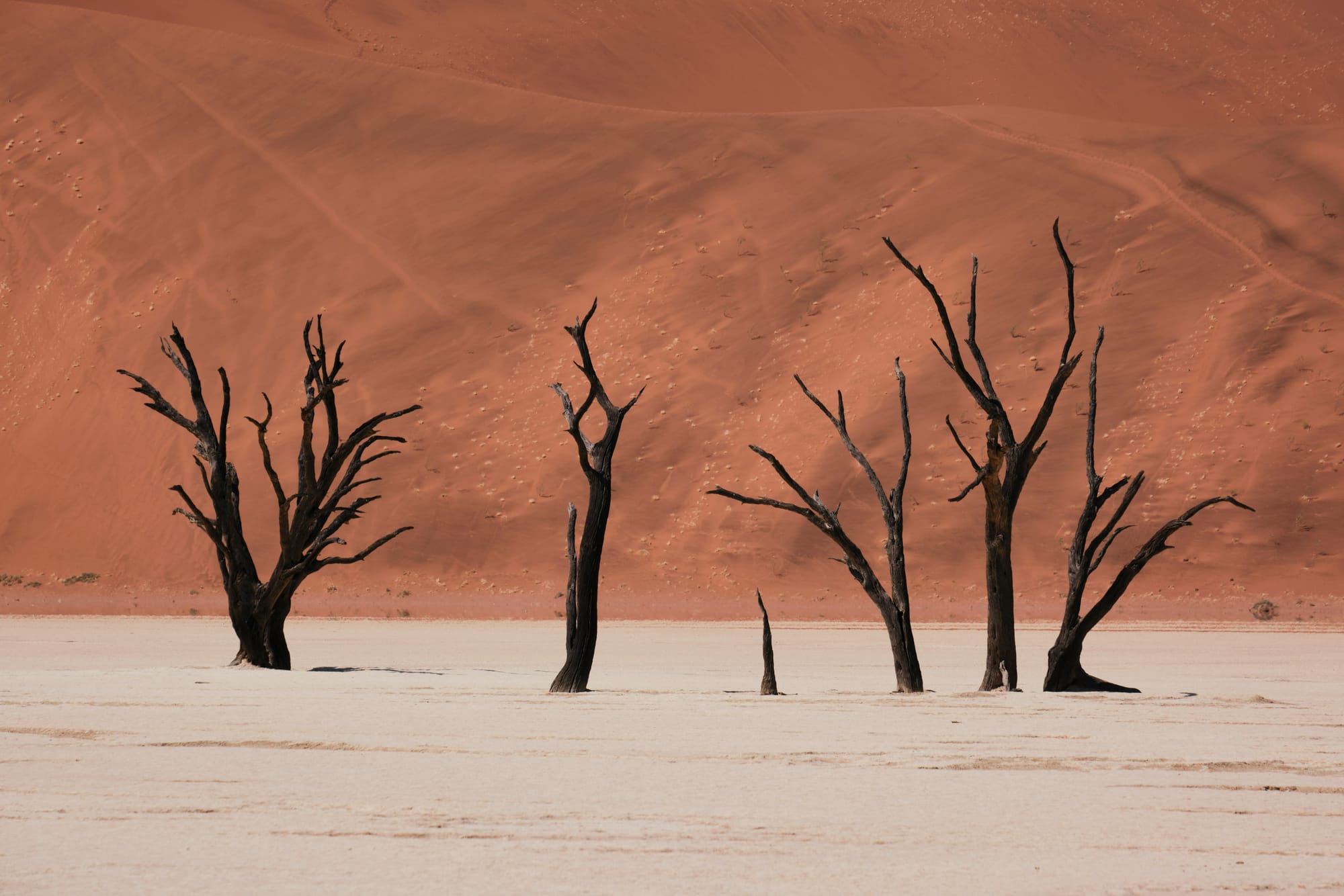
They died nine hundred years ago.
The camel thorn trees of Deadvlei — standing in a bleached clay pan in the Namib Desert, surrounded by some of the tallest sand dunes on Earth — have been dead since approximately 1100 AD, when the river that fed them changed course and the water disappeared. The desert claimed the pan. The trees died.
But they didn't fall.
The air here is too dry for decomposition. The sun is too relentless, the climate too extreme, for the ordinary processes of decay to operate. And so the trees remain — blackened by centuries of sun, stripped of everything except their essential form, rooted in white clay against a backdrop of blood-red dune — exactly as they were when the last leaf fell nine centuries ago.
They are, in the most literal sense, the most enduring things in the landscape.
And they have been dead the entire time.
What Endurance Actually Looks Like
We have a cultural image of endurance that is almost entirely wrong.
In the stories we tell, endurance looks like strength. Like forward motion. Like the athlete who pushes through the wall, the entrepreneur who keeps building after the setback, the person who gets knocked down and gets back up, visibly, defiantly, in a way that makes for a good photograph.
The trees of Deadvlei tell a different story.
Endurance, in its deepest form, is not about motion. It is about rootedness. About holding your essential form through conditions that would reduce lesser things to nothing. About remaining — not triumphantly, not visibly, not in a way that anyone is necessarily watching — simply because you are too fundamentally yourself to do otherwise.
The trees didn't survive by fighting the desert. They survived by being, at their core, something the desert couldn't take.
The Things That Strip You Down
There are periods in a life — in a career, in a relationship, in a creative practice — that function like the Deadvlei climate.
They remove everything that isn't essential. The comfort, the confidence, the easy forward momentum, the sense that things are going the way they're supposed to go. Sometimes they remove things you didn't know you were depending on until they were gone.
This process is not pleasant. It is not supposed to be.
But what it reveals, when it's done, is the actual structure of the thing. The real shape beneath the growth. The roots that were there all along, holding even when nothing above the surface was visibly alive.
The question worth sitting with, in those stripped-down periods, is not when will this end but what is still here. What has not been taken. What, in you, is too essentially itself to decompose.
That is the thing worth building from.
Nine Hundred Years of Not Falling
There is something almost defiant about the trees of Deadvlei, if you look at them long enough.
They are not alive. They are not growing. They are not doing anything that the living world would recognize as thriving. By any conventional measure, they lost — nine hundred years ago, the water left and they died and that was the end of the story.
Except it wasn't.
They are still there. Still rooted in the pan where they grew. Still reaching upward with the same branching form they had when they were living. The dunes have shifted around them, the centuries have passed over them, and they remain — not despite what happened to them, but somehow because of it. The very conditions that killed them preserved them. The extreme that ended their life extended their presence beyond anything a living tree could have managed.
Not every loss is the end of the story. Sometimes the thing that takes everything is also the thing that makes you impossible to erase.
On Being Stripped to the Essential
The philosopher Seneca wrote, two thousand years ago, that adversity is the opportunity to discover what you actually are. That the comfortable life reveals nothing — it is only under pressure, only when the easy options are gone, that a person finds out what they're made of.
The trees of Deadvlei have been making that point for nine centuries, more eloquently than any philosopher.
What they're made of, it turns out, is enough.
Not enough to keep living. Not enough to keep growing. But enough to keep standing — through drought and heat and the indifferent passage of enormous amounts of time — in the form that was essentially theirs.
That is not a small thing.
What the Desert Keeps
The Namib keeps the things that can survive it.
Not by being gentle. By being so extreme that only the most fundamental things remain. The sand that the wind has carried here is the sand that was too heavy to carry further. The life that exists in this desert — the fog-basking beetles, the sidewinder snakes, the desert-adapted elephants that walk fifty kilometers to water — is life that has been reduced to its most efficient, most essential form.
And the trees of Deadvlei, which are not alive and have not been for nine centuries, are perhaps the most honest expression of this principle: that what endures is not always what thrives, but what holds its essential form against conditions that would erase it.
You don't have to be growing to be standing.
You don't have to be thriving to be rooted.
Sometimes the most enduring thing you can do is simply refuse, at whatever cost, to fall.
Still There
The river changed course nine hundred years ago. The water disappeared. The trees died.
They are still standing.
Whatever the desert is in your life right now — whatever condition is too dry for ordinary growth, whatever circumstance has stripped the leaves and the easy forward motion away — the question the trees are asking is a simple one.
What in you is too essentially itself to fall?
Find that. Root there.
The rest can take care of itself.
Deadvlei is located within the Namib-Naukluft National Park in Namibia. The camel thorn trees are estimated to have died approximately 900 years ago and are preserved by the extreme aridity of the desert climate.
