Read the Water: What Surfing Teaches You That Nothing Else Can
The wave doesn't wait. You can be perfectly positioned, perfectly prepared — and if you hesitate at the moment it reaches you, it's gone. Not delayed, not rescheduled. Gone. Most of life works exactly the same way. Surfing just makes it impossible to pretend otherwise.

The wave doesn't wait.
That is the first thing surfing teaches you, and it teaches it fast. You can be perfectly positioned, perfectly prepared, paddle timing exactly right — and if you hesitate at the moment the wave reaches you, it is gone. Not delayed. Not rescheduled. Gone, rolling toward shore without you, and now you're paddling back out to wait for the next one.
There is no negotiating with a wave. There is only reading it correctly and committing, or missing it entirely.
Most of life works the same way. Surfing just makes it impossible to pretend otherwise.
The Ocean Is Not Your Friend
This is the thing that well-meaning surf instructors sometimes soften and shouldn't.
The ocean is indifferent to you. It was moving before you arrived and it will be moving after you leave, on a timeline that makes your presence in the water a footnote. It will give you the best rides of your life and, without malice or intention, hold you down long enough that you genuinely wonder if you're coming back up.
Learning to be in an environment that is fundamentally indifferent to you — that does not respond to effort or attitude or how much you want something — is one of the more valuable educations available to a person. It strips away the magical thinking that effort always produces commensurate reward. It replaces it with something more honest: that preparation matters, timing matters, reading the situation correctly matters, and that even when all of those things are right, sometimes the wave does what the wave does.
This is not pessimism. It is accuracy. And accuracy, in the water and out of it, is what keeps you safe.
The Paddle Out
Nobody talks about the paddle out.
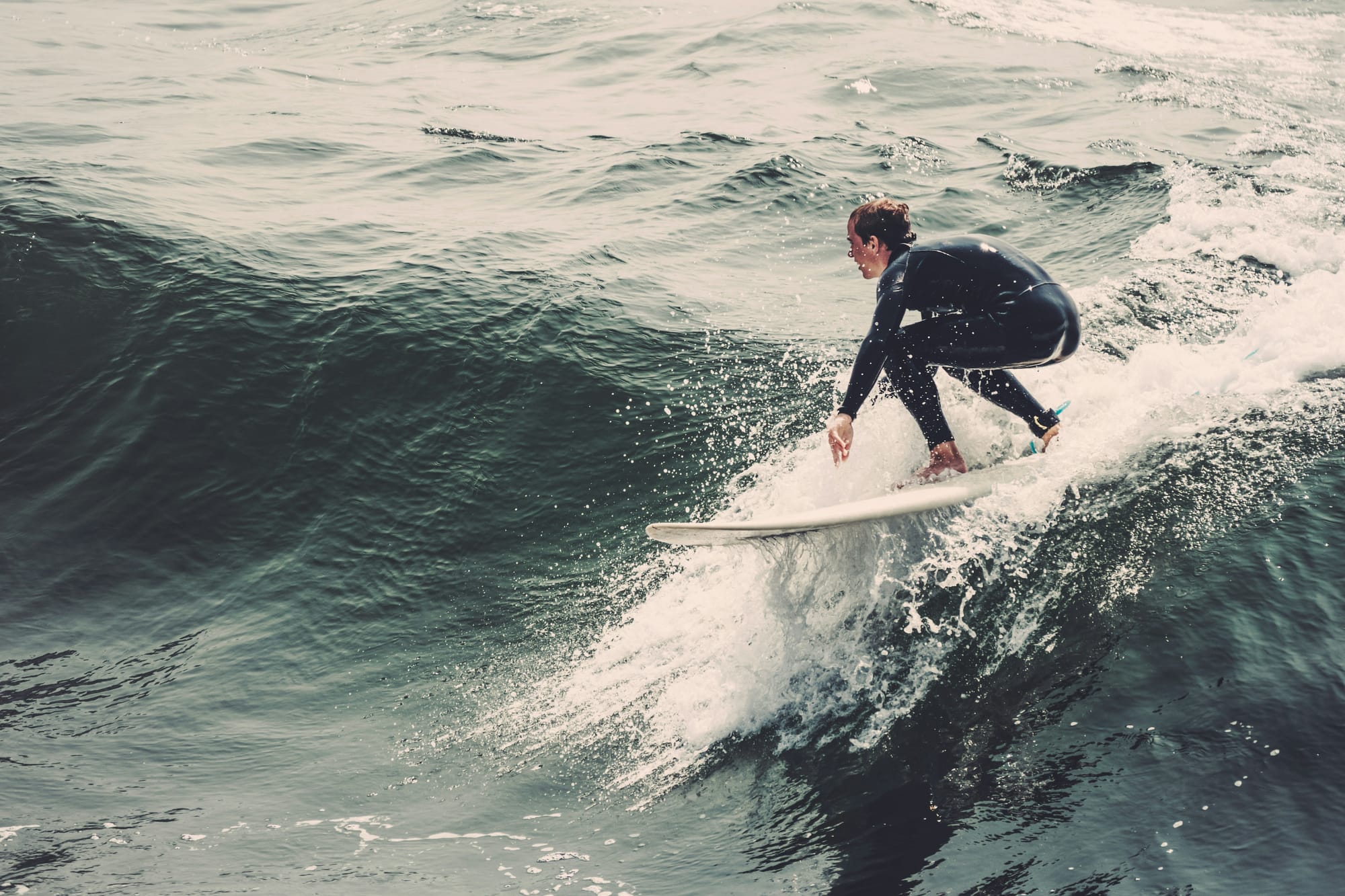
The photograph shows the ride — the surfer on the wave, board angled, spray catching the light. That is the moment worth capturing. That is the thirty seconds that makes the session.
What the photograph doesn't show is the forty minutes of paddling before it. Duck-diving under walls of whitewater. Arms burning. Getting pushed back by a set that arrives exactly when you've finally made progress. Starting again.
The paddle out is not the point of surfing. It is the price of surfing. And the price is non-negotiable — there is no other way to get to where the waves are breaking than to go through everything that stands between you and there.
The people who last in the water are not the ones for whom the paddle out is easy. It is never easy. They are the ones who have accepted, without resentment, that the paddle out is part of the deal. That the price is worth paying. That every session begins with going through the difficult part before you get to the good part.
Most worthwhile things work this way. Surfing just makes the structure explicit.
Timing Is Everything
Surfing is a masterclass in timing, and timing cannot be fully taught. It has to be developed — through repetition, failure, and the gradual accumulation of a feel for the water that no instruction manual can give you.
The surfer who catches every wave they paddle for is not stronger than the others. They are earlier. They read the swell further out, they position correctly before the wave arrives, and they are already moving at the moment the energy reaches them rather than reacting to it after the fact.
This principle — be early, read what's coming, be in motion before the moment demands it — transfers completely to almost every domain of life. The career move made before necessity. The conversation had before it becomes a confrontation. The decision made from position rather than from crisis.
Surfing teaches it physically, in the body, in a way that intellectual understanding alone cannot. You feel the difference between being early and being late. You feel what correct timing is, in your arms and your balance and the acceleration of the board beneath you.
That feeling, once learned, is difficult to unlearn.
Falling Is Part of It
Every surfer falls. The best surfers fall constantly — they are, by definition, attempting things at the edge of what's possible, which means falling is a regular feature of every session.
What distinguishes experienced surfers from beginners is not that they fall less. It is how they fall, and what they do immediately after.
You learn, with enough time in the water, to fall correctly — to protect your head, to relax rather than tense against the impact, to let the wave take you where it's going rather than fighting a force that will always win. And then you learn to surface, reorient, and paddle back toward the break without drama. Not because falling doesn't matter. But because the water doesn't give you time to treat it as a crisis.
The reset after a fall is a skill. In surfing and in everything else.
What the Wave Gives You
Here is what experienced surfers struggle to explain to people who haven't felt it:
The ride — the actual seconds of being in the right place on the right wave at the right moment, everything working, board and water and body in a conversation that requires your complete attention — produces a quality of presence that is genuinely difficult to find elsewhere.
You are not thinking about anything except this. Not because you've forced the other thoughts away, but because the wave doesn't leave room for them. The present moment is not a concept in the water. It is a physical requirement.
That is what people are chasing when they paddle out at dawn, when they drive hours to find a working swell, when they stay in the water until their arms are useless and the light is gone.
Not the photograph. Not the story to tell afterward.
The thirty seconds when there is nothing except the wave and the ride and the complete, involuntary presence of being exactly where you are.
Read the Water
Go to the beach before you surf. Watch for twenty minutes. Watch where the waves are breaking and where they're not. Watch the sets come through and count the time between them. Watch how other surfers are positioning and where they're catching waves and where they're missing them.
Read the water before you get in it.
This is the advice every experienced surfer gives beginners, and most beginners ignore it because they want to be in the water, not watching from the shore. The watching feels like delay. It feels like not doing the thing.
It is the thing.
The wave you catch well was read correctly from a distance before you paddled for it. The life decision that works was observed and understood before you committed to it. The read happens first. Everything else follows.
Get in the water. But read it first.
The ocean is the same everywhere. The lessons are available at any beach, on any wave, to anyone willing to paddle out.
