Protecting New Reality: Why Privacy Is the Innovation We Keep Failing to Build
Most people didn't consciously decide to trade their privacy for convenience. It happened incrementally, in fine print nobody reads, in default settings optimized to share rather than protect. Each step seemed minor. The aggregate was transformative.

There is something telling about the way we talk about privacy in 2026.
We talk about it the way we talk about sleep, or time with family, or eating well — as something universally acknowledged to be important, routinely deprioritized, and vaguely aspirational. Something we mean to get around to. Something we know we should protect but haven't quite figured out how to, practically, given everything else that's going on.
Meanwhile, the architecture of the digital world we inhabit is built, in large part, on the systematic dismantling of it.
The Trade We Didn't Consciously Make
Most people did not sit down one day and decide to trade their privacy for convenience.
It happened incrementally, in the fine print of terms-of-service agreements that nobody reads, in the default settings of devices and platforms optimized to share rather than protect, in the slow normalization of surveillance as the background condition of digital life. Each individual step seemed minor. The aggregate was transformative.
We gave away location data in exchange for maps that worked. We gave away social graphs in exchange for platforms that kept us connected. We gave away purchase histories, search queries, reading habits, sleep patterns, and emotional states — the last one measured by engagement metrics that know, with uncomfortable precision, which content makes us anxious enough to keep scrolling — in exchange for services that were, genuinely, useful.
The transaction was real. So was what it cost.
What Privacy Actually Protects
Privacy is not about hiding.
That framing — the "nothing to hide, nothing to fear" argument — is one of the most persistent and most damaging misconceptions in the public conversation about digital rights. It reduces privacy to a concern for people with something shameful to conceal, and in doing so, it misses what privacy is actually for.
Privacy is the condition that makes autonomy possible.
When you know you are being watched — by an employer, a government, an algorithm, a platform — you behave differently. Not necessarily because you are doing something wrong, but because observation changes behavior. It narrows the range of things you are willing to try, to say, to search for, to believe. The chilling effect of surveillance is not theoretical. It is measurable, documented, and consistent across cultures and contexts.
A person who cannot think privately cannot think freely. A society in which all behavior is visible and recorded is a society in which conformity becomes the path of least resistance. That is not a future worth building toward, regardless of how useful the apps are.
The Innovation Excuse
The technology industry has, for two decades, operated on the implicit argument that privacy and innovation are in tension — that protecting one requires sacrificing the other.
This argument has been remarkably effective. It has allowed the collection of data at a scale and intimacy that would have seemed dystopian to anyone who thought carefully about it in advance, justified on the grounds that the alternative was slower progress, less personalization, fewer breakthroughs.
It is also, increasingly, demonstrable nonsense.
Privacy-preserving technologies — differential privacy, federated learning, end-to-end encryption, zero-knowledge proofs — have advanced to the point where the trade-off between privacy and functionality is a choice, not a necessity. The most capable AI systems in the world can now be trained on data that never leaves individual devices. Personalization can be delivered without central data collection. Security can be built without surveillance as its foundation.
The new reality does not demand that we choose between innovation and privacy. It demands that we stop pretending we have to.
Who Bears the Cost
The privacy debate is not evenly distributed.
The people most harmed by the erosion of digital privacy are not, generally speaking, the people building the systems that erode it. They are the people with the least power to opt out — those in jurisdictions with weak data protection laws, those whose economic circumstances make the trade of data-for-service less optional, those whose identities make surveillance more dangerous.
The journalist whose sources can be identified through metadata. The activist whose location data can be subpoenaed. The teenager whose emotional vulnerabilities are being mapped in real time by platforms optimized to exploit them. The ordinary person who simply wanted to search for a medical symptom without that search becoming a data point in a profile sold to an insurer.
Privacy is not a luxury concern. It is, increasingly, a matter of safety — and the people for whom it is most urgently a matter of safety are the ones least represented in the rooms where decisions about it get made.
Protecting the New Reality
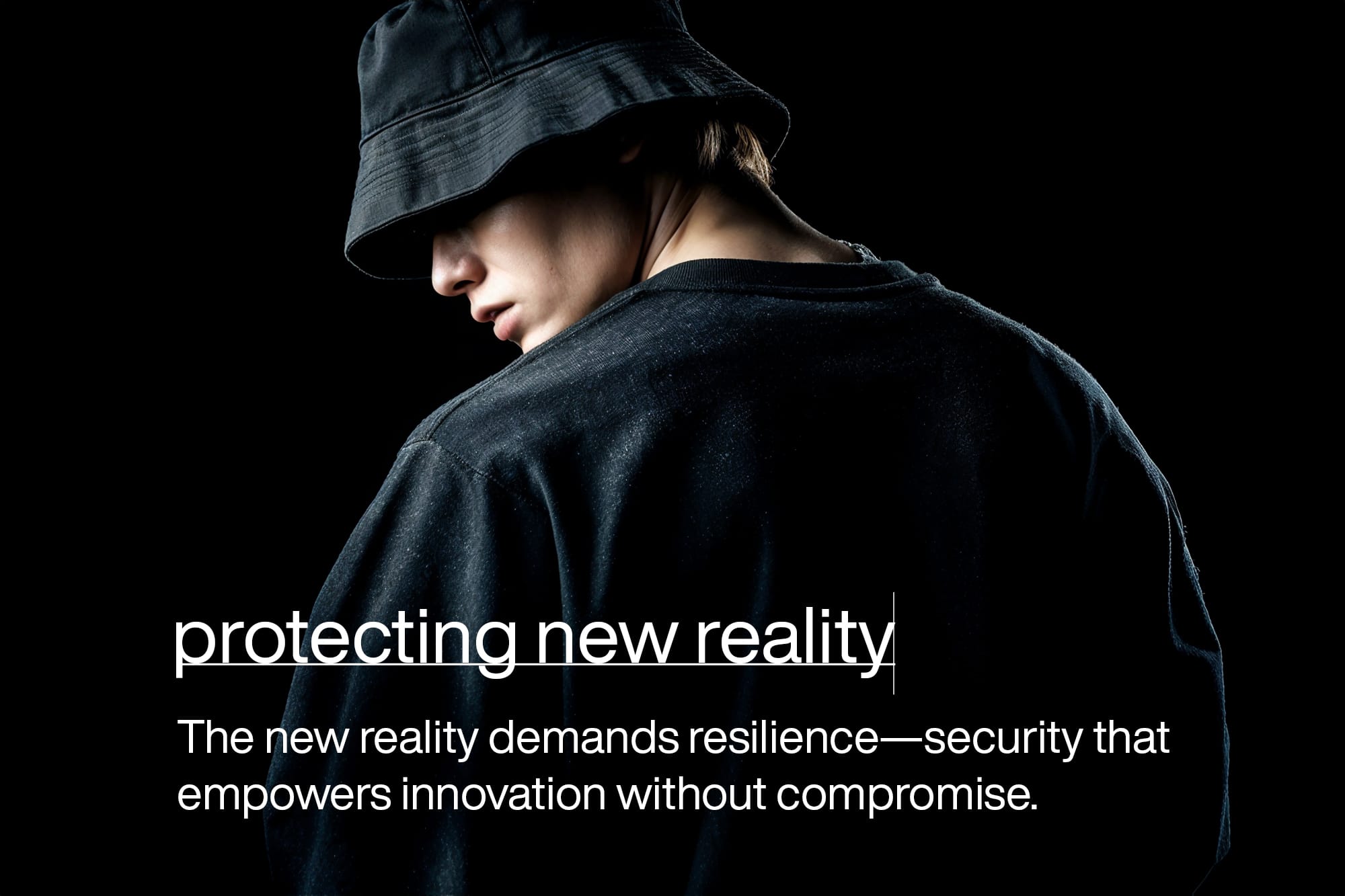
The subtitle of the image that prompted this piece says it clearly: security that empowers innovation without compromise.
That is the correct framing. Not privacy versus progress. Not safety versus functionality. Security — real security, built into the architecture from the beginning rather than bolted on afterward — as the foundation that makes everything else possible.
This requires choices. From the companies building the systems. From the regulators setting the rules. From the individuals deciding which platforms to use and which to abandon. From the engineers who can choose to build differently — and increasingly have the tools to do so.
The person who turns away from the camera is not hiding. They are asserting something.
That some things are theirs. That not everything needs to be seen. That the right to a private self — to thoughts, movements, relationships, and questions that belong to you and not to a data broker — is worth protecting, worth demanding, worth building a new reality around.
It always has been.
Opinions expressed in this article are those of the author and do not represent the editorial position of this publication.
