Into the Oldest Desert: Why Namibia Is the Most Extraordinary Journey You Haven't Taken Yet
The Namib is the oldest desert on Earth — 55 to 80 million years old, older than the mountains that frame it. When you stand on top of one of its dunes at first light and look out over the landscape, that age is somehow present. You can feel it.

The Namib is the oldest desert on Earth.
Not the largest. Not the hottest. But the oldest — somewhere between 55 and 80 million years, depending on which geologist you ask, making it older than the mountains that frame it, older than most of the life forms that have learned, improbably, to exist within it. When you stand on top of one of its dunes at first light and look out over the landscape, that age is somehow present. You can feel it. The scale of time, compressed into sand.
There is nowhere else on Earth quite like this. And most people will never go.
That is their loss. And, for now, your opportunity.
Why Namibia
Namibia does not make itself easy to visit, which is a significant part of why it remains one of the last genuinely uncrowded destinations on the African continent.
It is large — larger than France and Germany combined — with a population of under four million, most concentrated in the north. The distances between places of interest are enormous. The roads, outside the main highways, require either a 4x4 or a very high tolerance for uncertainty. There is no mass tourism infrastructure, no package-tour ecosystem, no conveyor belt of arrivals moving through scripted experiences.
What there is, instead, is space. And silence. And the particular reward that comes to travelers willing to do the work of getting somewhere that isn't waiting for them.
The Dunes of Sossusvlei
The dunes of Sossusvlei, in the Namib-Naukluft National Park, are the images that appear when you search for Namibia — and they are, in person, even more extraordinary than the photographs suggest.
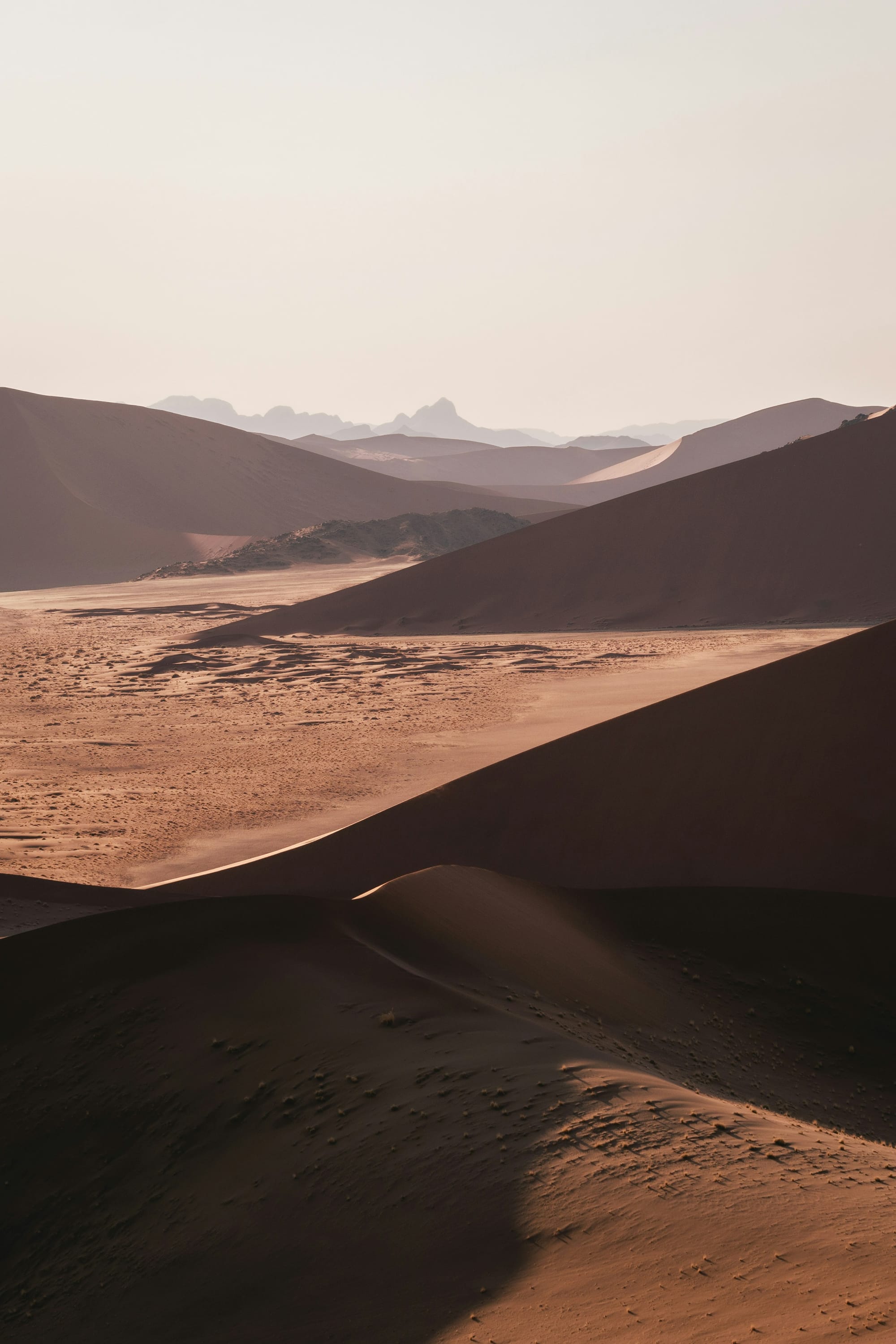
The tallest dunes here — Big Daddy, Dune 45, the unnamed ridgelines that stretch to the horizon in the hazy middle distance — rise to nearly four hundred meters. Their color shifts through the day: rust-orange at sunrise, blood-red at noon, deep brown in shadow, the ridge lines knife-sharp against a sky that never seems to fully commit to blue. The contrast between the dark, wind-sculpted flanks and the bright crests where the light catches is the kind of visual geometry that makes photographers put down their cameras because no photograph will do it justice.
Wake up before dawn. Drive through the park gate the moment it opens. Climb Dune 45 — a forty-five minute ascent on soft sand, harder than it looks, worth every step — and watch the light change over the pan below.
Then walk into Deadvlei — the ancient clay pan ringed by the tallest dunes, populated by the skeletal remains of camel thorn trees that died nine hundred years ago when the river changed course and the water disappeared. The trees are still standing. They are too dry to decompose. They have been standing in this pan, surrounded by this sand, for nine centuries.
Stand among them. Take the photograph. Then put the camera away and just stand there.
The Skeleton Coast
North of Swakopmund, the Namibian coastline becomes something else entirely.
The Skeleton Coast — named for the whale and seal bones that once littered its beaches, and for the ships and men that the cold Benguela Current and the treacherous offshore fog claimed over centuries — is one of the most remote and inhospitable stretches of coastline on Earth. It is also one of the most beautiful.
The northern Skeleton Coast, accessible only by small aircraft and closed to independent travelers, is the preserve of a handful of ultra-remote camps that offer guided exploration of a landscape that most humans have never seen and never will. Desert-adapted lions. Elephant herds that have learned to survive in near-waterless terrain. The confluence of desert and ocean — two of the planet's most extreme environments meeting at the waterline.
The southern section, around the Cape Cross Seal Colony and the ghostly diamond-mining town of Kolmanskop, is more accessible — a long day's drive from Swakopmund on roads that will test any vehicle — and rewards the effort with a landscape that feels genuinely post-apocalyptic. Kolmanskop, abandoned in the 1950s, is slowly being reclaimed by the desert. Sand fills the rooms of the old German colonial buildings to window height. The light through the broken windows is extraordinary.
Etosha and the North
A Namibia trip that doesn't include Etosha National Park is an incomplete one.
The park's central feature is the Etosha Pan — a vast, flat, calcrete-covered depression that stretches for nearly five thousand square kilometers, blindingly white in the midday sun, shimmering with heat mirages that make the herds of elephant and wildebeest in the distance look like they're floating. Around the pan's edge, a series of waterholes draw wildlife with a reliability that makes game viewing here unlike anywhere else in Africa.
You park at the waterhole. You wait. Everything comes to you.
Lion, elephant, rhino, giraffe, cheetah, leopard — all present in Etosha, all observable from the waterholes if you're willing to sit quietly long enough. The black rhino, critically endangered and increasingly rare elsewhere, is seen here with a frequency that nowhere else in Africa can match.
Stay in the park camps. Wake up before dawn. Be at the waterhole when the light is still pink.
How to Do It
Namibia rewards independent travel more than almost anywhere else on the continent — but it requires genuine preparation.
Self-drive is the right way. A 4x4 is essential for anything beyond the main highways. Carry extra fuel, extra water, a good paper map, and the understanding that cell coverage is intermittent at best. The roads are generally well-maintained on the main routes; the secondary tracks are another matter.
Plan for distance. The drives between major destinations are long — Windhoek to Sossusvlei is five hours on good roads; Sossusvlei to Swakopmund is three; Swakopmund to Etosha is six. Build in extra days.
The light is everything. The Namibian desert is at its most extraordinary in the hour after sunrise and the hour before sunset. Plan your movements around the light, not the convenience.
Book camps early. The best accommodation in Sossusvlei and around Etosha books out months in advance, particularly during the dry season (May through October) when game viewing is at its peak.
Stay longer than you plan to. Everyone who goes to Namibia wishes they had stayed longer. Build in the extra week before you go.
The Thing About Emptiness
There is a quality to Namibia that is difficult to describe to someone who hasn't experienced it.
The country is, by any measure, empty. The distances are vast, the population sparse, the infrastructure minimal. There are stretches of road where you will drive for an hour and see nothing — no other vehicle, no building, no evidence of human presence — just the road and the desert and the sky.
Most people, arriving from cities, find this initially unsettling. Then, after a day or two, they find it the opposite.
The emptiness is the point. It creates a quality of presence — of actually being where you are, completely, without distraction — that is increasingly rare and increasingly valuable. You cannot half-experience Namibia. It demands your full attention, and in return it gives you something that no city, no matter how beautiful, can replicate.
Go. Stay long. Come back changed.
Best visited during the dry season, May through October. The rainy season (November through April) brings its own beauty but significantly complicates travel on secondary roads. Windhoek is the main entry point, with connections from Johannesburg and several European hubs.
