Above It All: New York City Seen, Felt, and Understood From the Top Down

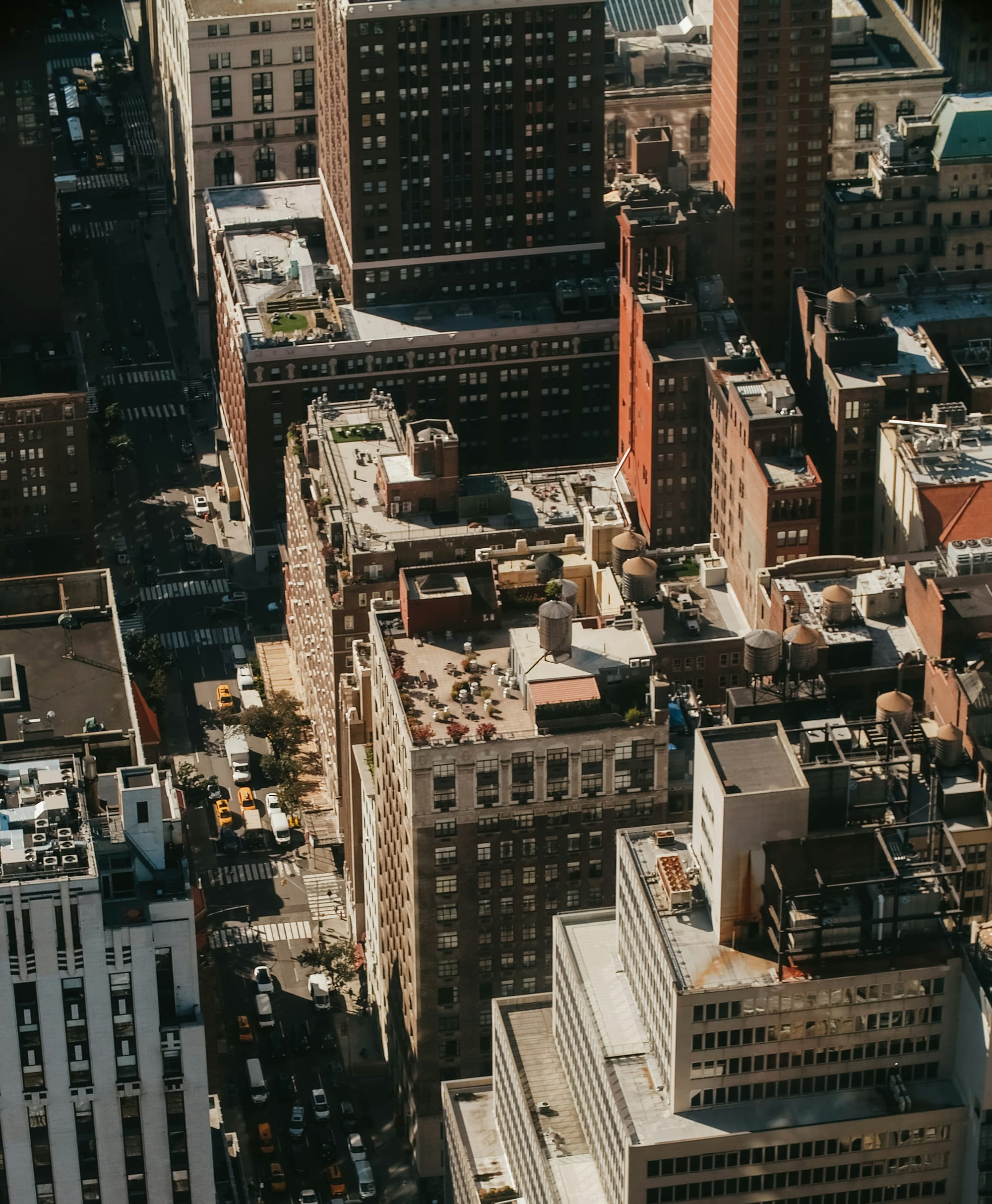
From above, New York makes sense in a way it never does from the street.
The grid resolves. The density — which at street level feels like pressure, like the city pressing in from every direction — becomes pattern. You can see the rooftop gardens tucked between buildings, the water towers standing sentinel on every block, the yellow cabs threading through canyons of brick and glass like blood cells through a circulatory system that has been running, without pause, for over two centuries.
The city is alive up here. It is also, from this angle, comprehensible — a machine of extraordinary complexity, doing exactly what it was designed to do, at a scale and intensity that no other city on Earth replicates.
Then you go back down. And it becomes something else entirely.
The Architecture of Ambition
New York was never built to be beautiful. It was built to be useful — to pack the maximum amount of economic activity into a finite island and keep it running at maximum capacity regardless of weather, season, or circumstance.
That the city is beautiful is almost accidental. A byproduct of ambition and competition and the accumulated decisions of thousands of builders and architects working across two centuries, each one trying to outdo or outlast the last.
The result is one of the most visually complex urban environments on Earth — not because anyone planned it that way, but because nobody planned it at all. The pre-war brick towers stand next to mid-century glass curtain walls stand next to contemporary towers of folded steel, all of them compressed into blocks so narrow that the facades are often more visible from the upper floors of neighboring buildings than from the street below.
The water towers are the detail that surprises most first-time visitors who look up.
Every rooftop in old New York has one — wooden stave cylinders, unchanged in design since the 1880s, holding water pressure for the floors below. They are the city's most honest architectural element: purely functional, undesigned, and yet somehow perfectly proportioned against the skyline. The fact that they still exist — that the most technologically dense city in the world still relies on 19th-century wooden barrels for water pressure — is one of the better metaphors New York offers for how it actually works. Old systems, kept because they function. New layers built on top of them. The whole thing more durable than it has any right to be.
The Rooftop City
What the aerial photograph reveals, and what most visitors never see, is that New York has a second city on top of the first.
The rooftops of Manhattan are a parallel landscape — gardens, terraces, water towers, mechanical systems, the occasional basketball court, the rarer rooftop farm — invisible from the street and extraordinary from above. In the older neighborhoods, where the building heights are more consistent, the roofscape has a horizontal continuity that the vertical facades below don't suggest. It is quieter up there. The sound of the city arrives as a background hum rather than the wall of noise it is at street level.
The green roofs — visible as patches of color in the aerial view, small gardens on the tops of buildings that from the street show nothing but stone and glass — are a more recent addition, part of a decades-long effort to reintroduce permeability and life into an island that paved over almost everything. They are small. They matter more than their size suggests, absorbing rainfall, reducing heat, providing the particular psychological benefit that comes from any living thing in an otherwise mineral landscape.
The Street, After the View
The best way to understand New York is to see it from above first and then walk it at ground level — the view from the rooftop, the experience on the pavement.
The grid, so legible from above, dissolves at street level into the specific texture of each block. The hardware store that has been on the same corner for forty years next to the restaurant that opened last month. The building facade that has three different eras of signage layered on it, the oldest visible only in the ghost letters left by paint weathered down to brick. The subway entrance that descends into a system that moves millions of people a day through tunnels that in some places date to 1904.
New York rewards the walker who is willing to look. Not just at the famous things — the skyline, the park, the landmarks that appear on every list — but at the accumulated evidence of continuous habitation. The layers. The repairs. The thousand small decisions that make a block feel like a place rather than just a location.
Five Things Worth Seeing Differently
The High Line. Not the destination it's become — the crowd, the food vendors, the Instagram compositions. Go early, before the crowds, in the blue hour just after dawn when the light is flat and the city is quiet. Walk it slowly from end to end. Look at the buildings at eye level and above. The whole point of it is the lateral view, which is unlike any other view the city offers.
The Brooklyn Bridge, on foot. Not for the photograph from the walkway — though that photograph is worth taking — but for the experience of the structure itself. The cables. The gothic arches. The century and a half of wire and stone holding everything together over the river. Stand in the middle and look downtown. Give it the time it deserves.
A rooftop, any rooftop. The bars and restaurants have them. The better hotels have them. The view from the top of any building in Midtown or Lower Manhattan at dusk — when the light turns the brick warm and the windows across the city begin to glow — is one of the better things a city has ever produced.
The outer boroughs. Brooklyn is known. Queens is known enough. The Bronx, for most visitors, exists as a name on a subway map. This is a significant oversight. The Grand Concourse — a four-mile art deco boulevard built in the 1900s and lined with residential buildings of genuine architectural ambition — is one of the most undervisited streets in any major American city. Go.
The water. Manhattan is an island, and most visitors forget this entirely. The Hudson River Park along the west side. The Brooklyn waterfront looking back at Lower Manhattan. The Staten Island Ferry, which is free, and which gives you the approach to the skyline from the water in a way that no other vantage point replicates.
What the City Teaches
New York has been teaching the same lessons for two hundred years, and they are available to anyone willing to stay long enough to receive them.
That density, handled correctly, is not claustrophobia but energy. That the proximity of millions of different lives — different languages, different hours, different ambitions — produces something that no smaller, simpler place can replicate. That the city's famous hardness is, in large part, the efficient callus that forms when you are surrounded by too much of everything: too much noise, too much need, too much beauty, too much failure, all of it in close proximity and continuous operation.
And that somewhere in the middle of all of it — in the rooftop garden nobody sees from the street, in the corner diner that has been making the same coffee since 1962, in the hour before the city fully wakes up and the grid is yours alone — is something worth coming back for.
Every time.
New York City is served by three major airports. The subway runs 24 hours. The best time to visit is when you can — the city rewards every season differently.
